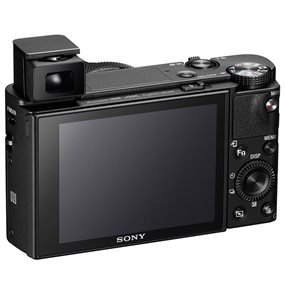
Отзывы о Фотоаппарат Sony Cyber-shot DSC-RX100

710 отзывов пользователей o Sony Cyber-shot DSC-RX100

Пользовались Sony Cyber-shot DSC-RX100?
Поделитесь своим опытом и помогите другим сделать правильный выбор

Profile no image

Скромный эксперт

18.05.2013

10/10

Оценка пользователя

Великолепно

The Sony DSC-RX100 has been extensively reviewed here and elsewhere by amateurs, enthusiasts, and professionals alike. I have discovered no un-reported features and tend to agree with the many, many positive comments that have been made while sharing little enthusiasm for the few criticisms that have been levied. Repeating what others have said would therefore seem as tedious as it would be pointless. Like most, I have found the Sony RX100 to be fast, small, easy to use, highly customizable (RAW + JPEG, manual modes, all the most modern shooting modes), well crafted, and capable of producing images of very high quality.What I will try to articulate is perhaps a fresh perspective on this wonderful camera, particularly for those who travel, who like to shoot without drawing a lot of attention to themselves, or who are recently returned to serious photography, which I define as shooting with an eye towards attaining high quality images. Once a long time ago I fancied myself an enthusiast. I owned a Nikon FM2 equipped with fast 28, 50, and 105 mm fixed length Nikor lenses, shooting a variety of conditions and subjects with low ISO, consumer-grade Kodak and Agfa print and slide film. But during grad school - what I now call the "lean years" - I needed money and sold the whole setup. I married soon thereafter, had a couple of kids and, being settled, needed to capture those precious moments. So my wife and I bought, kept, discarded, or replaced a whole series of point-and-shoots, first film, then digital, as well as an early 6.2 MP Canon DSLR with a 28-150 or so Canon zoom, which we still have. My wife did most of the picture taking and the cameras were mostly of her choosing.As time progressed my growing contempt for fuzzy, facebook-quality images, iPhone cameras, our collection of point and shoots, and my wife's Canon (nice, but I swear like 5 lbs) grew until I decided to purchase a camera of my own. But what to buy? Paramount would be the ability to acquire high quality images - rich, accurate colors, high resolution, RAW and JPEG formats, and nice dynamic range - using the smallest possible package. To me photography is a very conspicuous process where the degree of conspicuousness is driven by the perceived complexity and size of the rig used to shoot. Lug that DLSR with a massive zoom lens supported by its own monopole to the Little League game and you'll get first class images. But the other parents are thinking "picture guy" and if you turn it in their direction they'll duck and cringe. Take what is perceived as a point-and-shoot - sure, sure, not the equivalent but... - and people will assume you have point-and-shoot motivations and ignore you. And, while it is beyond dispute that no point-and-shoot (including the RX100) can rival the best images that that same DSLR can produce, it is also true that they are heavy and clumsy. Bulk and conspicuousness therefore have the paradoxical effect of rendering the equipment most capable of capturing fine images the very equipment I am least likely to haul out take some snaps or pack for a long trip to Europe.Now the RX100. Very inconspicuous - you can take it anywhere and everyone seems relaxed because who doesn't like a snapshot, right? People ignore you - you're the dunce with the clown camera. Better still, you can put it on a lanyard, hang it around your neck, and carry it around in the breast pocket of a shirt - it looks like you've got your work badge and a pack of smokes in there. Its quick startup, rapid zoom, and easy mode setting do make it a great point and shoot but it's extremely capable of more thoughtful composition, though no one is the wiser. I find myself taking it places I would never take our big Canon DSLR. How about that trip to Europe? Do I really want to drag a DSLR and three lenses around while floating down the canals of Venice? I lived in Europe for years and humped that Nikon SLR setup from one end of the then free world to the other. Once, while changing lenses at Checkpoint Charlie during 1985, when the East Germans were rebuilding it and it was being guarded by loads of Germans and Russians wandering about, I accidentally strayed onto THEIR side and was nearly apprehended at the point of an AK-47. The RX100 features a nice zoom (no need for that 28, 50, and 105 anymore - adios East German border guard dudes), good light gathering ability, and an extremely compact, balanced wrapper. Like other compact, fixed lens systems the advantages conferred by small size and simplicity simply overwhelm the DSLR when it comes to light travel and inconspicuousness.And image quality? I would say I'm at a loss for words but I've saved a few. Marvelous. Superior. Rich. Sharp. Surprisingly good. Side by side comparisons with my wife's Canon DSLR show better resolution and only a slight loss of dynamic range. I'm not thrilled with the macro, which seems to produce images that are kind of creamy and a bit too soft for my taste, but at normal focal lengt
источник
Profile no image

Скромный эксперт

10.03.2013

10/10

Оценка пользователя

Великолепно

With the RX-100, Sony has raised the bar for compact cameras. This small camera provides most of the flexibility of a much larger, heavier, and more expensive digital SLR (dSLR) or digital Semi-Transparent Lens (dSLT) camera, or even of a somewhat larger, heavier, and more expensive Mirror-less Interchangeable Lens Camera (MILC) such as Sony's NEX line of cameras. The RX-100 allows the photographer to control the shutter speed, aperture, ISO, auto-focus area, etc., and creates RAW format images, in addition to the less useful JPEG images. Also, the RX-100 menu system is reasonably intuitive, and easier to manage than the menu system of Sony's NEX line of cameras, about which you can read numerous complaints. The RX-100's 1" sensor is roughly 3 times larger than the 1/2.3" sensor of the typical compact camera, and consequently provides much better image quality than any other compact camera, with the obvious exception of the Sony RX1 compact camera that has a full-frame sensor, and that is roughly 4 times more expensive. The RX-100 boasts a high-quality Zeiss 28-100mm lens, which at 28mm has a maximum aperture of f/1.8 that is very impressive for a compact camera. The RX-100 is a valuable addition to a serious photographer's toolkit, and is as well a viable entry point for the amateur photographer to learn and practice the basic principles of serious photography.However, you get what you pay for, and although the RX-100 sensor is superior to the sensor of any compact camera of similar size and somewhat similar price, its sensor is no match for the sensor of a full-frame compact camera, a full-frame digital SLR, a half-frame digital SLR, or a half-frame MILC camera. For example, the dxomark website provides the following ratings of the sensors for various Sony (and other) cameras, based on measurements of the Color Depth, Dynamic Range, and Low-Light ISO characteristics of those sensors: RX1 full-frame compact (93), A99 full-frame dSLT (89), A77 half-frame dSLT (78), A57 half-frame dSLT (75), NEX-7 MILC (81), and RX-100 compact (66). Viewed from the perspective of these DxO ratings, the RX-100 sensor is in a class with Sony's first dSLR camera, the A100 that DxO gives a rating of 61. So, on one hand, the RX-100 provides equivalent image quality to the A100 dSLR, but on the other hand, the RX-100 image quality falls far short of the quality of the A99 dSLT or RX1 compact.But even considering the superior image quality of a dSLT camera such as the A99, this large, heavy camera is of no use to you unless you are able to take it with you. And taking a large, heavy camera everywhere you go is impractical. So, finally, this issue shows the strength of the RX-100. It is small, light, and unobtrusive, so you can take it with you frequently, and you will have it available to take high-quality photographs, even if those photographs are not of the highest possible quality that you might obtain with a larger, heavier, and more expensive camera.If you insist on the highest-possible image quality in a compact camera, and you are willing to pay for that quality, consider the RX1 instead of the RX100. The dimensions of the RX1, in terms of height, width and depth, are 113mm by 65mm by 70mm, whereas for the RX-100 those dimensions are 102mm by 59mm by 36mm. The weight of the RX1 is 482 grams, whereas the weight of the RX-100 is 240 grams. So, the RX1 has twice the depth and weight of the RX-100, a fact that makes the RX-100 a less obtrusive compact camera. The RX1 has a 35mm f/2 lens, whereas the RX-100 has a 28-100mm f/1.8 zoom lens, but the aperture of the RX-100 lens is f/1.8 only at 28mm, and decreases steadily to f/4.9 as the focal length increases from 28mm to 90mm: f/1.8 at 28mm, f/2.8 at 35mm, f/3.2 at 50mm, f/4 at 70mm, and f/4.9 at 90mm. The RX1 costs $2,800, whereas the RX-100 costs $650.Sony provides a downloadable, 68-page English/Spanish "Digital Still Camera / Instruction Manual" in PDF format for the RX-100 that doesn't give enough detail to be fully useful However, if you perform a Google search, you will find a 227-page or a 261-page much more comprehensive "Cyber-shot User Guide / Sony RX-100 User Guide" in PDF format, that is similarly downloadable from a Sony web page, although Sony doesn't provide any apparent clue that this more comprehensive manual exists. And, if you need even better instructions on the use of the RX-100, you can perform a Google search for Friedman Archives and buy the 425-page "The Complete Guide to Sony's CyberShot RX-100", which, at a price of $21.45 in PDF format, would still be cheap at twice the price.One caveat that you can find on page 203 of the 227-page version of the comprehensive "Cyber-shot User Guide / Sony RX-100 User Guide", or on page 235 of the 261-page version of that guide, is the fact that connecting the RX-100 to a computer via the USB cable can be idiosyncratic. In particular, you may need to connect the USB cable directly to the computer, i
источник
Profile no image

Скромный эксперт

22.05.2013

10/10

Оценка пользователя

Великолепно

I've had 35mm, 8mm film, video tape, digital tape and SD/HC cameras for over 50 years now, and while I've never been a professional (had my own darkroom for a time) I've enjoyed capturing Nature and Industry, Art and Architexture and my kid's (and now my grandkid's) life events. I've been through lots of formats and equipment keeping up with technonogy and I can't say for sure, but this might just be where my need for more and better ends. A couple of years back I bought a highly rated super-zoom camera (won't mention the brand as the best of them have the same flaws) that had 12 mp and videoed in AVCHD. Anything better would have required stepping up to a DSLR and multiple lenses and more nonsense than I was already used to. It didn't take long to realize the fatal flaws of the super zooms, lousey optics, poor low light images and videos, still larger than a point and shoot. Fine for family night but no photo images to be any more proud of (and maybe less so)than my 48 yr old 35mm SLR. With an upcoming two week Lifetime trip to China it was time to step up to the cash register once more (er-ah hit the add to cart button). I picked up my Sony DCS RX 100 at the UPS shipping facility in Redmond WA. at 9AM the same day we left on our trip at 2:30PM. Bearly enough time to charge the Batteries and fly through the instructions to learn how to turn it on (actually it's incredibly intuitive if you have any recent vintage point and shoot. Included instructons are almost non-existent but cover the basics.) Knowing I would not have time on tours etc. to do much else, I had already decided to stick primarily to the IA position and point, and shoot. I did, and I have been amazed at how easy it was to get great looking photos under a variety of lighting conditions. Pictures, tons of pictures. Rapid fire shots. night shots of buildings at night. Pictures from the busses (OK there's no way to get great pics through the window of a bus but some weren't that bad). And video. Under all lighting conditions. With a dedicated video button there's no need to dial up the video position. And press the shoot button during a video and you can take a photo with no interruption. I brought my 10.5" tablet along and was amazed when I saw the enlarged pics. The lens isn't a super zoom, 3.5x maxing out at 100mm, but with a HUGE (for a point and shoot) 1" CMOS sensor, a 1.8 Carl Zeiss lense system and 20.2 megapixles you can blow up anything taken at less than 1/100 sec. with little loss of detail. One comment. I really did stick to IA for all shooting. I discovered the dedicated panorama position at about day 3 and it's amazing too. Only after returning home did I check out the IA+ position on the dial and realize I should probably have done all my shooting in this position (I tried a couple of test shots under low light condition and saw little difference but who knows). I took all video in the MP4 codec (plays on my tablet natively and most other places on the web) but it will also record .264, 720 or 1080. Day or night, light or dark, the results, again, amazing. I have to mention the LCD, which is the brightest I've ever seen in bright sunlight. Usually I can't see a thing on the screen in bright sunlight so I tend toward viewfinders and this Sony only has an LCD. But I could always see what I was shooting or filming, even with the sun behind me. China is truely an amazing country to visit. Most worthwhile 2 weeks of any trip I've ever taken, and I can hold beautiful memories of it all in my pocket. Thanks, Sony, for making what will probably be my last photo/video product. A final point here about the 3.5x zoom lense. Anything greater with today's technology and there's a loss of quality, period. And whether for pics or video, unless you're using great quality tripod equipment and take a lot of time, counterproductive. Past 100mm it's pretty much impossible to hand hold a still or video (especially video) camera and produce an image worth viewing. On our China trip I did not once find a desire to xoom in any closer than the camera allowed. And if there were, you can enable digital zooming for still shooting and no-loss Hd electronic zooming for video. That's the advantage of the huge CMOS sensor and the 20 megapixles that are available.
источник
Profile no image

Скромный эксперт

01.10.2012

10/10

Оценка пользователя

Великолепно

I've been using this camera for about 6 weeks now. Briefly, it blows me away.Before I get into details of the camera, my own background in perspective. I'm a total amateur, who has gone in and out love with photography as a hobby. I had a SLR back in the film days, but really a mid level camera with a couple different lenses. Around 2006, I purchased a dSLR -- The Sony Alpha A100. I chose that model, simply because it was compatible with the lenses I already owned. I built up my gear, around that camera. Added a tripod, added a (old used) fast prime lens. In 2011, I took my family to Disney World, and was constantly making use of the whole camera setup. That was the high point of my dSLR use. Then slowly, gradually, I felt like I was being weighted down by the camera. Too cumbersome to carry all the time. Even when it was strapped to my back, too much of a chore to change the lenses. So when planning another trip to Disney World in 2012, the Sony RX100 caught my attention. dSLR quality, in my pocket. Could it really be that good?I'm sure that the Sony RX100 will not measure up to a top-of-the-line 2012 model dSLR. But I am very confident that it will generally match up well against a current model entry level dSLR. And it gets significantly BETTER results than my old 2006 dSLR.So when looking at the pros and cons, how does it differ from my 2006 dSLR?Probably the 2 most important elements in any camera, are the lens and the sensor. dSLRs have significantly bigger sensors than point & shoot cameras. A bigger sensor can capture more light faster, and typically therefore can produce far better results. The Sony RX100 sensor is still smaller than dSLRs, but it is significantly larger than almost any other true compact camera on the market. While still smaller than my 6-year-old dSLR, I'm guessing advances in sensor technology over the 6 years, makes up for some of the size difference. Turning to the lens -- a dSLR camera can change lenses. the RX100 only has 1 lens, but WOW -- It is an amazing lens, made by a well respected brand in lenses. The lens stops down to a 1.8 aperture at the widest angle. For those who don't know aperture, it means that the lens opens very wide, allowing more light to reach the sensor, more quickly. On the "included" lens that comes with most dSLR cameras, then aperture is not nearly as wide.So combine the above-average-sized sensor for a point and shoot, with a top of the line lens -- And you get results consistently better than my 6-year-old dSLR, with mediocre lenses.This sensor/lens combination gives you a lot of advantages, comparable or even superior to some dSLR/lens combinations. It shoots VERY well in low light. Sensor "sensitivity" to light is measured in ISO. My old camera maxed out at 1600 ISO. So even with a very wide aperture, I wasn't able to take pictures on dark rides at Disney. The RX100 maxes out in manual mode at 6400. (there are some auto tricks that raise it even higher). With ISO 6400 and the wide aperture, I was capturing usable images of rides in the dark at Disney.Another great advantage of the wide aperture is bokeh -- The ability to take a picture with a blurred background. It's fairly easy to achieve with a dSLR AND an extra lens. The lens included with most entry level dSLRs, won't have a wide enough aperture to achieve this effect. The RX100 achieves it with fair success. My SLR, with an extra lens, can still do it a bit better. But the RX100 probably does it better than any other compact camera.Finally, the whole system focuses very quickly and accurately. Typically, SLRs focus much faster than compact cameras. The RX100 focuses MUCH faster than my 6-year-old dSLR. The focus speed feels comparable to most entry level DSLRs.For someone with a real or developing knowledge of photography, this camera has the advantage of very full manual control. You can take control over just about any of the settings, and can customize various menus and settings to your liking. While common in dSLRs, this is not found across compact cameras.The camera has the pro of it's 20 megapixel sensor combined with the ability to shoot in "RAW" mode. This allows you to capture huge amounts of data in every photograph, which opens a lot of possibilities in post processing.The camera has a whole array of special modes, that are becoming increasingly common across cameras.The best ones that are included:In camera HDR -- Automatically quickly snaps 3 images and combines them. In the past, I could only do HDR with post processing, and generally had to take the pictures with a tripod. Now I can do it, in camera, hand held.Panorama -- Works the same as the new iphone.Handheld low light and similar modes -- Much like HDR, it combines multiple images. In this case, it combines the image results to correct for low light, or correct for camera shake.There are multiple other modes. For example, I've had fun with the watercolor mode, which turns th
источник
Profile no image

Скромный эксперт

30.09.2012

8/10

Оценка пользователя

Хорошо

I recently lost my beloved canon S95 and needed a replacement compact camera. I hesitated for a while between the much cheaper and ill-reviewed little brother of the S95 (S100) and this expensive new sony RX100 which everybody has been praising.When I opened the box I was surprised by the weight of the camera. This thing is small but heavy like a brick. With so much mass, I don't think that the camera would survive a 3 feet fall! Props to the engineers, it's amazing that the entire Carl Zeiss lens can retract into the body of such a small camera. Other than that, the sony RX100 looks really slick and reminds me of a Leica (not that I ever had one). A German camera it is not yet. I was in fact hugely disappointed by the finish of the camera. The trap doors for the micro-USB connector and the HDMI micro jack are so flimsy that I think Sony just asked some interns to design them. It's also likely that Sony is looking forward to people sending their camera for repairs, or just hoping that they buy the RX200 next year. I guess if you have a lot of money to throw around on cameras then it shouldn't be an issue. For me the joke doesn't end here. The worst piece of design on this is the flash. When it popped out I just started laughing. It's a $650 point & shoot and yet it has the lousiest flash I have ever seen on any camera. It's just ridiculous. I went in the menu and disabled the flash. I also assigned the flash button to an ISO button. This way I won't accidently pop it open and break this little piece of cr@p. Funny thing is, the manual advises people not to carry the camera by the flash unit. I guess everyone will have figured that by now.I read in many reviews that the RX100 was "made in Japan". Mine says "Made in China" and further investigation revealed that it's the case for every single RX100 that is on the market now. Thus, don't buy the sony RX100 because you think it's made in Japan. It seems to be something that sony did for the first batch of cameras knowing that the first reviewers would appreciate this detail.I then started to take some pictures out of my window and compared them to shots taken in parallel on my 6 years old entry-level Pentax 6M pixel DSLR equipped with a 18-55 lens from Sigma. I was less than impressed by the dynamic range and the colors on the Sony RX100. I heard people saying that the RX100 was as good as some recent DSLR. At first I seriously doubted it based on the test landscape shots I took. The colors were rather bland and the clouds overexposed although it was still early morning. Sure you can zoom in or crop the pictures taken on the Sony like crazy and get a better resolution than you would on a 6M pixel camera but this sony doesn't replace a DSLR when it comes to dynamic range.A few days later, I must admit that my opinion has changed a bit. You just need to figure out what this camera is good for. I started taking a variety of pictures and am now quite impressed. The sensor is very sensitive and the noise more than acceptable. I have shot many evening pictures in B&W and in color without flash at ISO3200 and am very satisfied with the results. The sony RX100 is indeed much better at this than my canon S95 or my Pentax ist DL2 DSLR. To be honest, it actually kills both cameras in this respect. Not sure how someone experienced with more recent DSLRs would feel about the ISO performance but I find it great. The shooting speed is also a big plus. I enjoy the movie mode as well. You can change the aperture and (slightly) throw the background out of focus which makes a huge difference with the canon S95 and almost every other point and shoot. I would not recommend zooming in and out while you shoot since the results aren't very smooth but overall the RX100 is quite good for shooting movies.One thing that I don't like is that several of the functions and modes are not compatible. For example shooting HDR and setting a timer while I have the camera on a tripod is not an option. This seems totally illogical to me and I don't understand why I can't do both to make sure that there's no camera shake. I do enjoy being able to set the camera to B&W and shoot a movie. This wasn't possible on the S95 for example. Still, I wish you could combine more modes and effects. Sony might release a software update but I wouldn't bet on it. They are probably too busy whipping their interns for the lousy trap door and flash design.That's about it for now. I have been shooting for about a week and am still having fun with the RX100. The camera is amazing for a point and shoot. Considering that I paid $400 for the S95 a year ago, I would say that the steep price of the RX100 is totally justified considering the difference in performance. Paradoxically, I can't help feeling that the RX100 is a bit overrated. It's not as good as a DSLR like some would like to pretend. I also really can't look past the fact that Sony decided to cut corners on the final design. I am really scared that I am going to b
источник
Profile no image

Скромный эксперт

06.09.2012

10/10

Оценка пользователя

Великолепно

This camera takes amazing pictures. I've been waiting for years for a small pocket-sized camera that could take SLR quality pictures. This is it.The low light pictures are phenomenal. I think it sees better than I do. I have yet to take a flash picture, because the results using a high ISO are so good. On top of that, the 1080 HD video is superb. This is the perfect travel camera.Well, not quite perfect. It has some minor irritations:The first is the documentation. Many features are barely explained. For example, want to know how close the Macro can focus? You won't find it in the manual (about 2 inches). Want to know why the zoom vibrates about 3 times a second when it is in continuous focus mode? No explanation. Because there was no explanation, I thought it might be defective, so I got on Sony's chat on-line with a Rep who said that it is supposed to behave that way because continuously varying the zoom is used to determine the proper focus. I still find it hard to believe. Sony could have explained quite a bit more with their in-camera documentation. The context sensitive help often has obvious un-helpful explanations (kinda reminds me of Microsoft) like the explanation for Manual Focus: "Focuses manually". Duh!The second is the confusing layout for all the options. The menus are overwhelming. All the features that can go in the function button are also in the menus. Four of them are pre-assigned to navigation wheel (display, exposure adjustment, flash and drive mode), and 7 can go in the function list. Those Eleven settings can be remapped by the user. With all this variation, I found that I could could not get the one function I wanted under a button -- setting a custom white balance. I can map all the white balance settings to a button, but I still have to navigate a menu to get to the custom white balance adjustment. If you put the white balance on the function list, you cannot set the custom white balance from that location! Oh well.Second is the control ring. It could have been better. It is hard to use it to zoom because it takes too much of a turn to go from wide angle to full telephoto. If you go to slow it gets jerky. When it transitions (in video) into digital zoom the zoom speed changes. It really should feel like a mechanical zoom, but it doesn't. Same too with focus. There is no feedback that lets you know where the focus is when you are starting. Nothing that helps you figure out which way to turn the ring when everything is out of focus. Is it focusing on infinity or 5 inches? No way to know if everything is blurry. Fortunately, there is DMF (no explanation in the documentation for what the "D" means) that focuses automatically, and then you can adjust the focus with the ring. That, along with the "peaking color" which shows you what in the picture is in focus, makes the manual focus usable. I'd prefer a focus indicator that doesn't distort the picture you are trying to compose. The focus ring changes function in different modes, and you can alter some of them. What it changes to, and in which mode, and which modes can be altered can be confusing and awkward. If you set it to zoom, you might be frustrated when it no longer adjusts the f-stop in manual mode.Third is the playback button. Pushed once when the camera is off and it will turn on. A second push will activate the camera lens, and this seems like it could be dangerous to the mechanism if it gets jostled in a camera bag. I will probably remove the battery if I think it might get bumped to much.Fourth is the lack of accessories. You'd think for this price that you'd get an HDMI cable (it has a micro jack) or make a power supply that also charges a spare battery. Heck, for the price you'd think they could put in a spare battery! Adding the possibility for Audio-in would be nice for video recording.Fifth is the price. It is pricey. But it really has no competition even with its quirks. It is an amazing achievement, and I expect to see competition from all the other major camera makers in the next year or so, which should bring down the price.A suggestion if you purchase this camera. I found little difference in performance with a SanDisk extreme or a Transcend Class 10 SD card. The San Disk is 3 times faster, but the camera's top writing speed seems to be close to the speed of the Transcend card -- about 15 MB/sec. In burst mode (JPGs), the San Disk was slightly faster. I clocked it at 2.3 pictures per second, compared to the Transcend which went at 2.0 pictures per second. The video works with a class 4 card according to Sony, so the only difference is burst mode.----------------Update 1/15/2013--------------For those of you interested in burst shooting in Raw Mode, the speed of your card WILL make a difference, and I'd recommend the SanDisk extreme. I find that the automatic settings that SONY uses to make a JPEG are as good or better than what I can do manually using their
источник
Profile no image

Скромный эксперт

28.08.2012

10/10

Оценка пользователя

Великолепно

Since I bought it in early August, I've taken >1000 photos, more than I took in the last 2-3 years! It's that fun.Before going into real review, I'd like to first alert you that the "Most Helpful Critical Review" for this camera that claimed the RAW format is NOT supported is completely wrong on this point.Sony's RAW file, ARW format, is a long standing proprietary format that's likely very well supported: After I took a RAW image with RX100, I did a quick Googling and then tried the first two well-reviewed free software that claimed to do RAW conversion - and both supported ARW! Both can open and then save to other formats. One is Photoscape, which has basically no feature support when doing the RAW conversion other than autoWB (Edit: I was wrong here, one could actually use 'Edit' feature after choosing the ARW file to make many adjustments in Photoscape too). The other is Raw Therapee, which has all sorts of controls available, and this is the one I'm going to use. Googling also finds a 2007 post on dpreview that said Adobe Photoshop Elements (watered down PS) does fast RAW conversion of ARW files. Another 02/2012 post claim Adobe Camera Raw 6.0 or 6.5 (free for PS CS5) supported ARW. And that critical review's dated 7/31/2012! It's just completely wrong. (Edit: there are others confirming that Adobe's support is just out, so that review might be about Adobe only, but its title and content both claimed no 3rd party (not just Adobe) support, which is definitely wrong).Now the real review:Instead of recounting all the pros and cons others have said so many times, I just want to write down my impressions on the camera from the angle of a complete photography newbie:1. Great image quality. Great colors, beautiful Bokeh effect. My unprocessed shots on flowers, portraits, match real photographers'. Low light performance is impressive.2. Great night shots. If you set camera on Superior Auto mode, and take a night shot by hand, it looks as good as anyone's. RX100 takes multiple shots and somehow combine them to improve lighting without blurring the image.3. In-camera panorama mode is convenient, but not that great. The adjacent images are frequently shifted (particularly obvious if there's human face in photo), the moving speed of the camera needs to be slow and the last part of the image sometimes were grayed out.4. In-camera HDR is really nice, and you can adjust the bracketing to some extent. Good on static objects. Combines only 3 shots though.5. Love the watercolor, had great fun with it.6. The Superior Auto mode is so great that I almost always keep it on. It does occasionally go into the wrong mode (ie, landscape instead of macro).7. Video qualities are very good, but I feel my Panasonic TM900 is still better except for color fidelity. A pity that RX100 doesn't take external mics but the audio is surprisingly good (maybe my expectation was low for onboard mic for such a tiny camera that's mostly for photos).8. Image stabilization is great. My hands are not steady, but even when Superior Auto mode takes several photos in quick succession, there's rarely a photo that comes out blurry.9. Many preset modes, and they work well.10. BIGGEST advantage: So small that I do put it in my pants or shorts pocket and take it anywhere - that's why I took so many photos so quickly!11. Another BIG advantage: No need to bring a lens kit with you! For newbies, no time/money wasted investing which lens to buy. Some might feel that you can't change lens with this, but I think Canon's EOS-M is a dumb idea. Why would I want to bring a big lens with a pocket camera? Doesn't that defeat the purpose of POCKET camera? If I want to use multiple lenses, I'd buy T4i instead.12. 3.6x Zoom is small. It needs to be bigger.13. Price is high, similar to low end DSLRs, but it's worth it because it takes DSLR-like photos but has the added advantage of being pocketable. You won't miss any precious shots again because you couldn't haul your big camera over.14. The flash is very bright. Auto-focus focuses well in near completely black, and the flash flashes an impressive distance.15. Reviewing the photo was easy. Navigating menus is also easy.16. My BIGGEST complaint: The distortion near edge starts early and very noticeable. If you take photo of people, I feel that even for people standing 8 feet away, only the middle half the area (not half the length, thankfully) do not have distortion. I wonder if it's just my camera.17. A tip: Say you enter Scenes mode and chose macro, and then you want to switch to landscape, it's fairly hard to find out how to quickly switch. I used to switch to auto mode, then back to Scenes and choose landscape. But later I accidentally found out that you just have to use the focus ring to change this setting! I know those that read manual probably discovered this already, but I never read any manuals for electronics, so this one took me some time. But I had no trouble with other things I want to do.18. Continuous shoo
источник
Profile no image

Скромный эксперт

16.08.2012

8/10

Оценка пользователя

Хорошо

Opted for the RX100 over the Panasonic LX7 because the image quality was disappointing to me, and wanted very high resolution anyway. The zoom is about the same, but the Panasonic has better f-stop. Still, 1.8 is better than your average camera, many of which are (commonly) 2.8 or 3.5.Image quality. Yes, an NEX has less noise at higher ISO because of its sensor 10mm larger (13mm on RX100 versus 23mm on NEX; APS-C). The sensor on the RX100 is 1", compared to the Panasonic at 1/1.7; 7-8mm. That said, the RX100's sensor is twice the size of the LX7 with twice the resolution (20MP versus 10MP). For example, the Sony CyberShot DSC-HX30V has the small 1/2.3" sensor (a few mm), but amazingly, at 18MP, the pictures at a higher ISO look hardly worse than at base ISO. Colors (indoors) are about the same on the HX30V, RX100, and NEX (I have all of these, the NEX-5N is the one I tested with the other two in my kitchen). Details are smudged a little on the HX30V, but that is due to the aggressive noise reduction. Amazingly, the highest ISO of 12800 on the HX30V is very good if you remain still enough. I got a very clean photo of my kitchen at night with extremely dim light from nearby yardlights. This seemed comparable to ISO 6400 on the RX100, but highlight clipping and noise were more of a problem. I am thinking that the noise reduction algorithm on the HX30V is superior to the other cameras mentioned. *** Yes, disregard what I said about the sensor. The sensor specs can confuse you. I will get to this matter in a short bit. ***Movie quality. They are all very clean in good and low light. The sound quality suffers equally; 48KHz sounds lossy (mathematical phenomenon, perhaps), where a camera such as Canon T3i (again, I have that one) records at 44.1KHz (CD-quality), the quality you would expect from a music CD.Hardware. The NEX doesn't focus as well or as quickly as the RX100, but the HX30V is the fastest, putting the RX100 in the middle. I haven't done very thorough testing yet, but what I am referring to is taking pictures out a car window (down) going about 35-40 mph. An NEX won't give you a clear shot, due to its slow lens with severe motion blur. The RX100 does a little better; closer objects with stronger motion blur than distant ones (zooming in, the results may be worse). The HX30V is so fast that most of the time, the images are clear, although the grass on the side of the road has some motion blurring. I am wondering if the smaller sensor on the HX30V makes a difference. In any case, an NEX series camera gives the best image quality, but the lenses (and no in-body stabilization) makes them good for still shooting. In addition, some focus hunting (contrast detection versus the much faster and more costly phase detection autofocus) occurs to an extent on any of these cameras. Whatever the reason, using progressive AVCHD seems to improve the quality, but that is most likely because the other formats are interlaced. What makes this partially NEX hardware, or a bit closer 'in the middle' is that the sensor is larger. I happened to question someone at work about the sensor at work, and what I was told is that the sensor size is the end result of a mathematical formula, not the actual size of the sensor. Therefore, using basic geometry to measure with a ruler isn't going to result in one inch. Do some research to find out if interested. Performance isn't quite up to the HX30V, but better than the NEX series. As said, this camera falls in the middle, so it is a better value than the NEX for roughly the same price range, but the NEX has the larger sensor for cleaner high-ISO images. Movies are the same, except for the following under software...Software. First, the user interface is that of the CyberShot (the RX100 is CyberShot, which makes sense). However, its features are very close to that found on the NEX series, hence, some limitations. This mostly applies to the Movie Mode, where the NEX-5N, for instance, can record Art Effects as does for photos, but on the HX30V, those art filters aren't available for Movie Mode, and so you're basic with shooting in color. The HX5V didn't even have B&W and Sepia for photos, so this is a welcome feature that should have been available as on many other cameras, such as Canon and Panasonic. On the RX100, I like the interface in the middle; like the NEX the least, and the HX series the best. The biggest gripe that I have, and it doesn't seem to make sense, is that the RX100 and NEX series don't support 720 (1280 x 720); just the standard VGA (MP4 640 x 480) and HD (MP4 1440 x 1080; AVCHD [MTS] 1920 x 1080)). The NEX series supports 24fps in progressive format for HD, but the RX100 cannot, and so the only progressive format is the 60fps that cannot allow dual recording (taking stills while recording), and the picture quality suffers on the RX100 as does the HX series during movie mode. NEX series cannot take photos during movie mode. I like it that the NEX and RX100 can display MP
источник
Profile no image

Скромный эксперт

22.07.2012

10/10

Оценка пользователя

Великолепно

As soon as I saw information released about this camera, I knew instantly I wanted to get my hands on it; it looked awesome and the specifications mentioned seemed incredibly impressive for a camera it's size, so when I finally got it(which of course made a big hole in my credit card), I was super excited to play around with the features and see what it could actually do and if it would live up to the expectations Sony had created about this camera.First impressions were definitely positive, it looks remarkably suave and holding the camera itself I found it to be really comfortable even though it only has one grip which is located precisely for your thumb. I personally think they got a good balance between grip and style, because if they had added any more grip it would have ruined that nice sleek design it has, for example if you take a look at the Sony Cyber-shot DSC-HX20V, you will see it has a huge grip which whilst gives maximum grip it does overwhelm the side of the camera.Included in the box are the following:Camera | AC adapter | Battery pack | Micro USB cable | Wrist strap | Two shoulder strap adapters | Manual.Things you NEED:SDHC Card (You can choose a different brand/memory capacity, though do remember as this is a 20MP camera, files sizes average around 5MB if your using Jpeg in fine detail, or is around 20MB if using the RAW format (RAW image has a '.ARW' file extension)).Optional:Camera Case (LCJ-RXA) | USB SDHC Card Reader | Spare Battery NP-BX1 | HDMI - Micro HDMI Cable | Anti-reflective Screen Protector- - -The main thing I love about this camera is it has modes which are great for people who don't have a lot of knowledge about cameras and just want to point and shoot whilst getting great results, and there are modes for those who know more about cameras and want to go more in-depth with the settings.The modes which I personally think are great for those with limited camera knowledge, I would suggest using the mode dial located on top of the camera to choose one of the following:1) Superior Auto; "This device beautifully shoots automatically while reducing blurring and noise".My opinion: I've always had great results with this mode, on most occasions it takes the picture I want it to, though sometimes you may want select a mode in the scene setting to get a little bit extra.- - -2) Intelligent Auto; "Automatically identifies the scene's characteristics and shoots a photo".My opinion: Pretty much the same scenario with the superior auto, it takes fantastic shots most of the time, though I haven't really noticed the difference between both of them, this may be because I haven't had the chance to test them in many varied locations.- - -3) Scene Selection; Here you can select different pre-setting modes to get the most out of certain scenarios:- Portrait; "Emphasizes subject by blurring away background. Reproduces soft skin tone".- Anti Motion Blur; "Reduces blur indoors with poor lighting or for telephoto shooting to obtain clear images".- Sports Action; "Shoots fast motion at higher shutter speeds".- Pet; "Shoots pets and other subjects in movement to reduce blur".- Gourmet; "Shoots food to look delicious".- Macro; "This mode is best suited for shooting close-ups of small subjects such as flowers and food in clear and sharp focus".- Landscape; "Shoots the entire range of scenery in a sharp focus with vivid colours".- Sunset; "Vividly expresses and dramatically captures the redness of dusk and dawn".- Night Scene; "Shoots night scenes clearly. Recommend using tripod".- Hand-held Twilight; "Suitable for shooting a night scene without using a tripod".- Night Portrait; "Automatically fires the flash to illuminate foreground subjects and engages slow shutter to capture background night scenes".- Fireworks; "Shoots beautiful fireworks without flash".- High Sensitivity; "Reduces blur even without using flash".You can select different scene modes by twisting the mode dial back and forth, twist the control ring(my favourite and the easiest way), or go to photo tab 5 which is located within the menu.My opinion: You have such a good amount of different options to choose from. Not only does the camera explain the best situation to use such scenes, but also shows a picture to give you a better idea of what scene they should be used in.I've had some great shots with the hand-held twilight setting, whilst I don't get perfect shots all the time, it has produced better results than all my previous cyber-shot cameras combined!I also really like the portrait mode.There is one option not on the list from previous models and that is the "Picture Effect" mode, this has been moved into the menu or can be selected via the function button (if selected), I would have preferred it to be in the scene selection, but that may be because I'm used to it being there.- - -4) Sweep shooting; "Creates a panoramic image while you move the camera left/right or up and down at a fixed speed".You can adjust the settings by going
источник
Profile no image

Скромный эксперт

19.07.2012

10/10

Оценка пользователя

Великолепно

I have NEX-7 and E-M5, I want to write some comparison notes here.RX100 is from Sony which have more similarity with NEX than E-M5, so this list is mostly compare the RX100 to the NEX-7, the NEX-7 have a wonderful hardware and bad implemented software really pi-ss me off.On contrary, this RX100 is an almost excellent camera both in hardware and software.Pros:1. Size of s100 with 1' sony sensor, the auto-focus is super fast and very accurate, much better than NEX-7, better than E-M5 with some lens but fail to match in the tele side.2. It charges with USB, I can attach it to my car charger or remote battery for my mobile phone in emergency.3. It unlike Olympus xz-1,Fujifilm x10, Panasonic lx5/lx7, Canon g1x, it has build-in lens cap, which makes it smaller and a LOT more convenient than those in real life shooting.4. ISO can be as low as 80, compensate some margin for the 1/2000s shutter speed(E-M5's 200 base iso is a horrible decision from Olympus)5. The software(operation system) is derived from Sony Alpha DSLR, unlike the NEX's bad UI implement from Sony P&S digital camera. It gives you 3 custom profiles, with their own iso range setting. different picture quality setting etc.6. The face detection can be set on for ALL light metering and focus mode. this is a big evolution from NEX(which can only used with matrix metering and multi-focus).7. 20m pixels is very good with pixel peeping or cropping, thanks to it's large sensor and quality lens, lots of details with base iso.8. It still keep the Sony camera's features:Sony's color profile. I really like this kind of realistic color rendering. Way better than Panasonic's wash-out plain dirty image and Olympus bluish white, more graduation than too much contrast Nikon, and less pink from Canon.Portrait mode have more dynamic range boost.(good trick from NEX)AF-illuminate light is useless.(turn it off immediately when you received your camera, good trick from NEX)Alpha DSLR's multi frame noise reduction is great for iso 3200 and upManual focus with focus peaking and zoom-inLot's filter effects can be applied to video and photo, HDR, Pano, Hand held twilight mode, they are still there.Exposure compensation and white balance you see on screen is identical to the actual shots.9. leaf shutter is almost silent. lower latency compare to NEX-7, super fast, that can sync flash with 1/2000s10. 10fps shutter stream with live view, this is a huge plus from NEX, and the buffer flush is very quick compare to NEX-7 with sandisk ush-i 45mb SD11. almost no screen lag between shots-to-shots(after you turn off the quick review, another trick from NEX/Alpha)12. dual dials control is very good, comparable to NEX-7 and E-M5(NEX-7's tri-dial is a totally hoax, most of the time, 2 of the dials are redundant with same function. )13. lens is exceptional, f1.8 can be used but there maybe some halos in daylight, starts from f2.8 is razor sharp. Macro shoot is amazing(see my photos uploaded to the product gallery)14. photo replay can be zoomed-in and then roll-over each photos to compare the zoomed parts. (NEX-7's tri-dial is useless here, all of them have the same function of roll-over to next photos)15. lots of customization with buttons.better than NEX-5n and comparable to NEX-717. Video function is better than NEX-7, it have more control, and concave dedicate movie button, which in comparison, NEX-7 have a protrude button, can be easily pressed by accident and record unnecessary movie.(Shame on you! Sony, 8 months w/o firmware fix for this!)18. Video active stabilization is effective, panning and zooming is butter smooth.19. dedicate modal dial, with memory recall and movie mode. memory recall can set up to 3 memories for the most distinguish settings, such as 1 for portrait(low iso base range, med shutter speed, portrait color rending, face detection ), 2 for landscape (80 iso, vivid color rending, small aperture), 3 for in-door flash portrait. You can alway record video in any mode with press the movie button, but in dedicate movie mode, you can set to automatic or manual, or Av, Sv and filters for your fine tune of movie style.20. flash can be set to bounce with your fingers, produce nice in-door photos. (good trick from NEX-7)21. white magic rgbw screen is very good, more vivid and bright than NEX-7 outdoor.22. battery is generally good in this category , I shoot 700 photos for half a day, So prepare 2 spare battery for a night and day shoot session.23. Since Adobe released Lightroom 4.2 RC, Raw file can extract more details for high ISO setting, but jpeg out of camera is better than what I expected as well as the vignetting, distortion, purple fringe compensation.Cons:1.front dial is smooth, the smooth dial is excellent for manual focus, but I prefer tick dial to adjust values.2.modal dial is a little tighten to turn.4.no dedicate on/off button for flash. it can only be triggered with menu option to use flash.5.Lens zoom out/in speed is not very fast, if you drop the camera, it ma
источник
Profile no image

Скромный эксперт

24.09.2013

10/10

Оценка пользователя

Великолепно

I really don't know anything about taking pictures. I'm the type that likes to just take pictures and not really care about shutter speed, aperture and things like that. I just want the camera to take superb pictures just by using the auto function. That's exactly what this little camera does. There are two auto functions on this camera: Superior Auto and Intelligent Auto. I'm not exactly sure what the difference is but both take very good photos (I think Superior is better though because it seems to take many photos at a time and chooses the best photo or something like that). The main reason why I got this camera is because it is very compact and as close as you can get to a dSLR from a point and shoot. Also another important quality I needed was to be able to take very good night shots even without flash. Does it do this? You bet! So these are the things I wanted from a camera but boy does it do so much more!Video quality is very good. At first I thought the video quality was pretty bad because when I uploaded my videos onto iphoto from my macbook air there was so much distortion (horizontal lines) that I thought it was a camera that was only good for taking photos. Boy was I wrong. After doing a little research, apparently you need to use some other video thing like Quicktime to truly see how good this camera is at taking videos. You can adjust your movie quality to even get HD movies. You can choose between AVCHD and MP4 but I think AVCHD is better quality. From playing around with the video quality out of AVCHD FX, FH, and PS, I think PS is the HD quality. FX and FH seem to be the same quality as MP4. So if you want to save space I think you can do well even with MP4 quality movies. But you're definitely going to be in for a treat with the PS mode.Battery life is pretty dang good. I've had this camera for about a month now and I feel like I almost never have to charge the camera. One time I took a 20 minute long video and I was still at full charge even after 80 more photos! If your a regular guy like me then the battery life should be good enough for you.The only con I can think of is the menu can take some getting used to. To me I don't do much much more than "Superior Auto", flash/noflash, 10 second shot, and movie mode. So even the complicated menu is not too bad since I rely on auto mostly.The main point about this camera is it takes great shots even for a guy like me that wants the camera to do all the work in setting up. It is a bit pricey though. However, after looking into other point and shoot cameras like the CANON S95-S110, the extra money seems to definitely be worth buying this camera especially when looking into build quality. There seems to be consistent quality issues with the Canon point and shoots (such as lens issues) but you really don't hear too many problems with the RX100.Important Note: For macbook users, you are able to upload the FX, FH, and mp4 videos directly to iphoto. However, the PS videos are usually not found. To overcome this simply click on the "SD card" icon on the desktop>click on "private" (all of these movies are made using PS mode)>click on a video which should automatically start the movie in quicktime>from Quicktime click on "File">click on "Duplicate">close the window (a popup should appear to save the file)>save the file on the desktop>now your PS file is on the desktop and you can upload to iphoto. Hopefully this makes sense.
источник
Profile no image

Скромный эксперт

04.07.2013

2/10

Оценка пользователя

Ужасно

This is the first time (and last time) I relied solely upon reviews in Amazon to make a decision to buy a camera. I was in a hurry with a vacation coming up and saw all of the rave reviews, making claims such as how the camera took better photos than their Nikon D7000. I decided to buy it.My first comment is that I took it on a trip and kept it in my jeans pocket just like I have always done with pocket cameras. In the past pocket cameras have spent countless hours in my jeans pocket with no adverse consequence. Within 4 days with the RX100 I looked at the viewing screen on the camera and there was a scratch across the screen.My next complaint is the video. I have for comparison a much less expensive Nikon pocket camera that I bought about 3 years ago. From experience taking videos I know that you have to pan slowly if you want the audience to comfortably view a video. I found that with the RX100 if you panned, even at a slow pace, horizontal streaks would appear in the recorded video upon playback, which greatly detracted from the video.I also noticed that the camera was slow processing shots and would take much longer than my older Nikon pocket camera, causing me to miss shots.As far as the size of the camera, I think Sony overdid it making it too small. It felt uncomfortably small in my hands, and I just didn't like the feel of the camera.The camera has a feature which somehow transforms a shot that you intended to be in landscape mode into a portrait shot of one person in the photo. It would then produce for the final photo not the shot that you intended but instead a portrait shot of the one person. I even put it on Landscape mode to force the camera to take landscape photos and it still extracted portrait shots of the person in the photo, leaving out the rest of the shot.Another thing was that it was promoted how the screen had some special qualities which made it easy to view what you are photographing when out in sunlight. That proved not to be the case. I found it nearly impossible to see anything on the screen when I was outside in bright sunlight.Lastly, regarding the quality of the photos, it does not even approach the quality of a Nikon D7000, which I happen to own. From what I could see it was no better than the aforementioned Nikon pocket camera that cost half as much years ago.I tried to return the camera and first, since it was fulfilled through Amazon but used a third party seller, I was informed that there was a 15% restocking fee and that is payable even if the camera and all paperwork and packing materials are in perfect condition. Since my screen had a scratch I was told that there would be a 30% restocking fee. Then another person in customer service told me that it was damaged, all the way through to the LCD, and that they couldn't take it back.I looked this up and found that the seller was exaggerating the situation in that the actual LCD screen is protected by a plastic cover that can be replaced if you buy a new back for the camera.Also, some brief searching online revealed that the plastic cover for the screen for the RX100 is extremely easy to scratch, and that you should buy a protective film at the same time you buy the camera.At any rate, I ended up giving the camera to my daughter because I couldn't return it.It would be an understatement to say that I was very disappointed with this camera. To sum up, I received poor value for my money. Sony should cease production of this camera because it will hurt their reputation.
источник
Profile no image

Скромный эксперт

10.12.2013

10/10

Оценка пользователя

Великолепно

This camera already has enough reviews about the specs and performance. I'll leave that out, but I'll share my experience of it as a casual photographer.As I get more exposure into photography, I start to learn about many photographs elements. I was pretty much thinking about upgrading to a DSLR after having played around with a superzoom, and learning that sometimes sensor size can cause a big difference. I also heard the phrase that the camera doesn't make the photo, it's just a tool for the photographer. I realize that, but I wanted a better tool than a 1/2.3' sensor size superzoom that would be more versatile for indoor and portraits. Also, I was a sucker for nice DOF effects, which is hard on a small sensor camera.Before looking at this P&S, I almost was going to jump into buying my first DSLR (a used 5D) for about the same price as I would have gotten this camera. Then I realized as a casual photographer who's interested in taking good pictures, it is a heavy investment in cameras to just be able to take casual photos that look nice. For me, I made the realization that if I choose to go down the DSLR route, I may just go around shooting with the "kit lens" that comes w/ whichever DSLR camera that I buy, if any, maybe one more lens that is +1 compared to the kit lens. It doesn't make sense.Moreover, I am starting to believe the phrase "The best camera you have is the camera you have with you". From speaking with other casual photographers like myself who own DSLRs, they more than often leave their cameras at home because it's too much gear and too heavy to lug around. This camera is the best camera to have with me when I go places. It takes great pictures, esp when I'm with others who don't have their DSLRs with them when we hang out.Since the 2 most important features I need as a casual photographer are low light capabilities for taking in door portraits and making professional looking photographs with DOF, this camera fits the bill w/o breaking the bank (comparing to buying a DSLR + lenses, of course). It's not cheap, but it gives me a sense of satisfaction to know that I can take just as good looking photos as I continue to hone my skill w/o having the temptation to spend money on gears that I will probably use only once or twice before letting them sit on the shelves collecting dust.In the future if I do decide that I've learned enough to really want to invest in a DSLR, this camera will STILL be a first choice for me to take around as it is pocketable. That's also a reason for me to get this camera first, learn more about photography, before deciding whether or not I really need a DSLR. At this time, the answer is no, but it may change.If you are a pro, or want to be like a pro, then this review won't be useful to you. However, if you are a casual photographer wanting to learn to take better looking pictures with a better tool, this camera will be a great choice for you, over buying a APS-C camera with a kit lens.
источник
Profile no image

Скромный эксперт

15.01.2014

10/10

Оценка пользователя

Великолепно

I am an avid photographer, not a pro but love to shoot pics of the kids and events etc. I always carried by Nikon DSLR around with a couple lenses and or 1 good telephoto 70-300 & a 50 1.4. I have been looking for that compact camera that I can just pick up and go or quickly grab it when I see something funny / goofy / cute that the kids are doing or if something catches my eye outside. Instead of breaking the DSLR out of the case & figuring out what lens I want to use etc. This camera has a fantastic 1.8 lens that is PERFECT for indoor low light photography without the need of a flash. How often have you wanted to shoot something in the house without a flash only to have the photo come out too noisy or our of focus. No more with this camera. I have bought several compacts over the last few years. My criteria was: Good Lens (of course) quick lens (1.8 is fantastic) with quick focus, Ability to shoot RAW files (I do a lot of editing in PS). and finally adjustability, Aperature / Shutter / Manual priorities. I didnt necessarily need a hot shoe, gps, wi-fi etc. I can simply take a quick shot on my phone to get my gps coordinates then load them all on my computer and it's all there.I have taken well over 1,000 shots with this camera over the last few weeks and couldn't be happier with the crisp focus of this little compact camera. It has a 1" sensor which makes it fantastic for low light (inside the house, night time, couple lights on in the house and want to take a quick, good shot of something, no problem without the need of the flash. I did not buy this camera to try to replace the DSLR, thats not what this camera is made for. It's primary function is to give you "close to DSLR" quality in a pocket sized camera. The only negative thing I could even think of saying about this camera would be the placement of the HDMI connection. It's on the bottom of the camera right next to the tripod connection. So if your all set up on a tripod and want to hook it to an external monitor, it would be very difficult. But... I didn't buy this camera to hook external monitors to it while on a tripod. I took it around to several locations that you normally feel out of place with a big DSLR wrapped around your neck and got fantastic shots quickly from pocket to shot in 3 seconds!I could go through many features of this camera but....... Ill just say this and save you some time because I spend, no joking, 40 hours researching cameras before settling on this one... If your looking for that grab it and go camera that shoots fantastic pics, RAW format and adjustably to be creative... Read the subject line again:) Stop looking! You found it.
источник
Profile no image

Скромный эксперт

09.02.2013

10/10

Оценка пользователя

Великолепно

I would like to start by saying that this camera is amazing. The quality of the pictures are excellent, the Carl Zeiss lens is amazing, it's easy to use, the ISO is perfect, color rendition is spot on, Auto Focus is crazy, the B&W pictures it takes are really nice, screen big and colorful, and the sharpness is perfect. I have it in a small Case Logic TBC-302 Ultra Compact Camera Case with Storage pouch and it fits really good in my jeans pocket, I take it everywhere. There are so many camera's out there that profess to be the best and have close to DSLR quality pictures but this is the real deal. This is the best pocket size camera out there hands down. It seems expensive because of the size, people automaticaly put it in the same category as a P&S, but it is not. It has a lot of features that you find on a DSLR camera like the Canon T3i/T4i with the size of an S95 just a tiny bigger. The flash is really good, but you'll find you don't really need it much because of the Zeiss lens 1.8, except for some indoor pics. The indoor pics are just as good as the outdoor pics, even the night pics outside are crazy.It's not only a good camera but it's also an artistic tool, if you're really into photography it has the options and image quality you need to get the pictures you want. I've been really happy with this purchase. Some reviers had mentioned the pop-up flash being and issue, it's not, it's cool and have no issues, just a little diffrent, many cameras have the pop-up now, you get use to it right away; and some people were complaining about the charger, after buying the camera their complaints don't make sense, you can plug it in a wall socket or pc, it has wall charger with a usb cable like a cell phone I love it, and it's compact. Some people always find the smallest and insignificant things to complain about.Orginally I had doubt's because of so many wack P&S cameras out there and the price, but after doing reasearch and looking at some pics online in Flickr and steve huff's website I gave it a try, I'm so happy I bought it. I thought the 1 inch Bionz sensor size and Zeiss lens was just another marketing hype but they are not, they work really well together. If you are looking for a profesional pocketable camera that you want to take everywhere this is it. I love Canons but I have been disppointed with the quality of a lot of my pictures with some of the Canon P&S's so I started looking outside of the box and I wound up buying a Sony, which I never thought I would; I could not be happier. Sony has really come a long way, and I would say they have some of the best camera's out there right now.Canon has some nice camera's and lens but it doesn't mean everything they make is perfect and that theres no other brands out there that make camera's that have the same quality and in many cases even better quality products. You just have to do your research and try it out and not just buy blindly based on passed experiences with a brand or just based on brand loyalty. That's what happened with me and Canon, I was limiting myself to finding excellent quality Cameras like the Sony RX100 and the Fujifilm xe1 because of my loyalty to Canon as a cutomer. As a loyal customer I tried Canon first but I did'nt find what I was looking for after several tries. I'm happy I did'nt just stick to something I was'nt happy with just because of the brand I have finally found something I can truly say I'm happy with and it was worth my money, the Sony Rx100, now I look forward to Sony's future camera's, I hope they continue on the path they've been on. Sony's on point right now, especially with the introduction of Zeiss lens, they've been putting a lot of time and resources into their camera division; definitely a good investment.
источник
Profile no image

Скромный эксперт

03.07.2013

6/10

Оценка пользователя

Плохо

BIGGEST CON: Only goes to F11 - any serious photographer will not even consider this camera because of this.I got this camera as a Christmas present. The primary use for me is in a housing to be used while scuba diving. I will say that for the above water pictures I have taken I am quite impressed with it. Overall the camera has a good feel (solid/sturdy/metal feel), but there's not a real good "hand grip" like the DSLRs have, which is disappointing. I can understand the desire to keep it small, but it would have been nice to just have a mounting point to put on a handle so one hand could hold the camera nicely.So far I have taken 2 (scuba diving) trips with it. The initial trip I used one of my son's strobes (Inon Z240) and a L&M Sola 1200 as a Video/flood light. For my 2nd trip I purchased 2 S&S D1 Strobes.This is my first foray into underwater photography using a "camera". Up until now I carted a long a L&M Video Housing for my Sony HDR-HC3 Hi Def video camcorder. This can also take pictures but only at 4 MP (it's not a new camera by any stretch of the imagination). But since I didn't have to worry about any settings I used it pretty much like a point & shoot.My first week was on a Digital Shootout sponsored by BackScatter on Cozumel in late April. We had some instruction on uw photography, but, as I quickly found out, nothing beats just getting in the water and shooting, shooting, shooting. I set my RX100 on Aperture Priority (as recommended) and played around. My picture quality is anywhere from pretty decent to horrible. I still need quite a bit more time to flesh out all the operations of this thing. That would be true for almost any camera these days - the electronics in them provides so much functionality that learning it is almost a bit overwhelming.*** During my experience I did notice one HUGE hole in the camera's capabilities and that is that it is limited to F11. Both of my sons cameras have a better range and they are much older than this one so it's more than a bit disappointing. The two other cameras (FYI) are an Olympus PEN-1 (12 mp) in an Olympus housing (Z240 & S2000 strobes) and a Canon T2i in an Aquatica Housing (which has caused us NO END of problems due to extremely poor design) with one single D1 strobe and a L&M Sola 1200 Video/Flood light. Even the older PEN-1 Olympus goes to an aperture of F22.I also got the macro and wide angle UW lenses that mated to the housing. I still have to review some of these pictures but getting to within an inch or so of some of these tiny subjects is just amazing. I did have one issue with the Wide Angle Lens but since this is all UW related I won't burden you with it here.So, time will tell whether I keep using this as a primary camera or buy a real DSLR and relegate this to a backup function.BTW, for those other users complaining about no external battery charger - you can buy one (it came in my package). It has a flip down two prong plug and can also double as a generic USB charger (there's a switch on the front) which may be convenient for some people.
источник
Profile no image

Скромный эксперт

24.02.2013

10/10

Оценка пользователя

Великолепно

I'm only a few hundred shots into my new RX100, but I can already see that this camera is going to be one of my very favorites of all time. "Amazing" is a very fitting way to describe this little powerhouse. Over and over again, the fine detail the RX100 captures in a wide variety of shooting situations is surprising and delightful, and it gets the job done quickly and efficiently. Colors are rich, and while the RX100's color rendering is more akin to the punchy rendering typical of small lens compacts than the Canon DSLR's I'm used to, it offers sufficient resolution, control, and versatility to produce really high quality images, and I'm looking forward to exploring this camera's unique personality. As someone else said in an article on the RX100, it's not just "good enough," it's "good!" In future generations, I'd like to see a lens that could maintain a shallower depth of field at longer focal lengths, and a hot shoe so I could mount my Phottix transmitter and use off-camera strobes. I could see neat possibilities with impromptu portraiture, still lifes, and such if you could trigger off-camera strobes. But the RX100 will do a top-notch job in most of those situations where you wouldn't be carrying a speedlite and and other gear, and much of the RX100's beauty and power comes from the fact that because it's so light and fits in your pants pocket, it can ALWAYS be with you. I found the controls easy to get used to and convenient enough. No, it's not a Canon 5D with a set of L lenses and speedlites. But it is seriously competent gear, and I think every serious photographer will have a blast and find a use for this pocket wonder.Update. I'm a couple weeks and many dozen shots deeper into exploring this wonderful machine. I'm even more impressed than I was when I wrote the comments above, if that's even possible. The one "weakness" I lament with this camera is that like all small lens cameras, it doesn't offer as much opportunity to shoot with shorter depths of field and blur the background like you can with a DSLR. But what it does best, over and over again, is deliver exceptional detail from edge to edge and corner to corner. It conveys depth exceptionally well, like when you're shooting down a long street or river. It rivals my Canon DSLR's in resolution and with low ISO's, the images are really impressive, even when you enlarge to 200% in photoshop. The intelligent auto is really intelligent! With a single press of the trigger, I've shot night shots that would have required several test shots and adjustments with my DSLR's. The in camera jpg processing is generally excellent and the auto white balance is really good, too. Auto focus is at least as fast as any other compact I've ever used. Truly amazing. Amazing hardware coupled with amazing software. The world of compact cameras will never be the same---the Sony RX100 has set an entirely new standard for what a compact camera can be. I'm really enjoying this camera, but also look forward to future generations of this new technology. As I said in my original review, I'd really like to see a version of this camera with a hotshoe so I could trigger off camera flash.The panorama function works well, but cuts the number of vertical pixels from over 3648 to 1856. That's still a lot of detail, but if you want the option of printing the images later in a really large size, it would be best to shoot a series of individual images and then stitch them together in photoshop the old fashioned way.
источник
Profile no image

Скромный эксперт

08.03.2014

10/10

Оценка пользователя

Великолепно

By the way, I have owned a Pentax Spotmatic and Crown Graphic in the old film days. And now have a Sony NEX 7 and a3000 (the a3000 is a second body). I also have and enjoyed the Canon G12 (an great camera when first sold). So I know the variables.Let me post the following as a guide: if you don't already own a suite of lenses, then don't be misled when someone says something like: this costs $500-650 (the new II cost $750) - you can buy a mirror-less camera for that. Well that's true. but by the time you buy a few lenses you have spent $2000 so the real cost is something else. And even if you own lenses, most of the newer cameras do significant camera processing and so you are better off with a lens built for your camera (to the pros- please don't argue, i know you spend your day with Lightroom, but the rest of us don't). so even if you have lenses, the new mirror less may not really work well with your lenses, so in the end your $500-700 camera will cost $2000.So to the person who wants a better sensor than the typical point and shoot, this one will amaze and impress. Yes it will!. And unless you really want to lug a camera bag with you on vacation (you do? ) then this will do most of what you could ever want without the bag. So when you've climbed on top of the mountain, or when your boat finally has gotten out to the whales, you can slip this out of a pocket (coat pocket, cargo pocket - it may be a tad to big for jeans pockets). and you are set.I want to comment on flash and low light. Both are specialties. If you want a better sensor AND want to take flash pictures - sorry, you may need to use a larger camera AND a separate flash. And by the way, i took flash pix at night in a church and did fine. but the camera may be slow to recharge. But remember, this is a tiny package.I took my NEX 7 on vacation last September, and though happy with the pictures, changing lenses on the mountain is tricky unless you are a professional. My son took the Rx100 and simply breezed through everything.You will love this - and if you can afford it, the Rx100 II.
источник
Profile no image

Скромный эксперт

22.01.2013

8/10

Оценка пользователя

Хорошо

Compared to these I have borrowed from friends or owned or had on trial for a week or more: XZ1, P310, LX5, S95, several superzooms, NEX5N....A./ Best combo of size and features of any compact out there....slightly smaller than an LX5, slightly bigger than a S95, because of its lens casing. This camera reminds me of an LX5, on a S95 body.B./ Will go in a pants pocket only if you are a man wearing "relaxed fit" jeans, or khaki casual maybe.C./ Absolute best ISO on a compact, pretty usable 1600. Drops quite badly at 3200 if not in well lit conditions.D./ Unimpressed with RX100's macro. I love macro, and wanted better. The Lumix LX7 is a great macro camera on a semi-pro body and at a very nice price compared to the RX-100. Ditto for Canon S110 if a small body is the single most important requirement.E,/ Reasonable WB in almost all scenes. The larger sensor may contribute: I dont know whether sensor physics or in-camera processing matters more for WB.F./ Digital extended zoom not as well done as Lumix or Canon.G../ Outdoor video great, but my FZ150 equal, and can do it with an amazing zoom. Indoor video very nice but, as with all compacts, not like outdoors. RX100 far exceeds XZ1, LX5, P310, S95 all of whom seem to put video in as an extra, which is fine , as long as you know that, and it is reflected in your purchase decision.Stills thru ISO800: RX1 rates A XZ1 B+/A- S95 B+/A- FZ150 B+ SX260 B/B+ LX5 B/B+ (WB issue) P310 B (noise) Zs15 B Video RX1 A FZ150 A- ZS15 B+/A- SX260 B+ LX5 B S95 B (720p) XZ1 B- (focusing) P310 C- (focusing)Conclusion:As a vacation camera, get the FZ150....great on an HDTV thru iso 400 or even 800, video equal to the RX100, and a clear image zoom out to about 32x !!For size, and for sharper ISO thru 1600, the RX100 if you have the bucks.For families, a much better all-around performer at even less money would be a NEX F3 or 5N, with a 18-55mm zoom. Much better ISO 1600 thru 6400, and therefore ability to use S mode and higher shutter speed to stop moving kids and pets. Again, for families, don't blow your budget on added lenses fot the NEX - the kit zoom is fine. Does everything the RX100 does and better, just physically larger to carry, but certainly ok in a purse, pouch, or on a neckstrap.For the pro who is constantly changing ISO/Aperture/Shutter/ev/WB....the RX100 is worth the money. It really is a tiny DSLR up to iso 1600... XZ1 could do in a pinch, as it is very controllable and just a step behind in ISO, very good 400 and better than most other compacts at 800...I now own a Sony NEX-5N : fantastic, has usable ISO6400 even indoors, but cumbersome interface. I also own a Canon SX260, mainly for its great zoom, price, and it can go in almost any pocket w/o worrying that you are going to break a $600 investment.After many, many trials, my opinion is: It is very difficult to beat the FZ-150 and SX260 superzooms: very good macro and great zoom at the same time, plus very acceptable Auto Mode, then throw in full manual adjustments and very good video.Forgetting price, for overall quality of both stills and video, buy the NEX 5N. For size, speedy interface, plus clear indoor iso800 and maybe iso1600 ability, the RX100 is really all there is as a non-interchangeable lens camera right now. Two money-saving nearly as good choices are the Lumix LX7 (small, half the money) and the Nikon P7700 (large, but many easily accessed controls, great WB, amazing thru ISO800...and a great price.)
источник
Profile no image

Скромный эксперт

10.08.2012

8/10

Оценка пользователя

Хорошо

I watered my so much loved LX3 a few month ago and since than was on a hunt for a better replacement. The first RX100 reviews amazed me, but my first thought was: 20MP is too much, 16MP would have been better for a 1 inch sensor. My LX3 had 10MP and made marvelous photos, so 10MP is already enough. What matters at the end of the day is pixel size, since the weakness of ourdays digital shooting is limited dynamic range (ever seen a 80 years old black and white tripod photo made from a 10x10 cm negative ? - breathtaking quality), and dynamic range is, in a first approximation, bound to pixel size. If I do the math, I find that the LX3 has a 1/1.63 inch sensor with 10MP, the RX100 has a 1 inch sensor with 20MP, so the each RX100 pixel is about 41% larger than a LX3 pixel. Not too big a difference.The RX100 is not yet (early August 2012) in the shops in Germany, so I bought it online from sony.de. Without going into details about this experience: never do it. A letter listing all the mishaps, slip-ups and bugs of my online and telephone service experiences is on its way to the CEO.The camera arrived July 20th. First impression: while my LX3 gives a sturdy impression, with the RX100 I felt and still feel as if I have to be very cautious with this little body. If you switch it on, the lens walks amazingly far out and speaks "do not touch me, your touch might derange my glasses". Not to mention the toy flash.Second cry was for a decent manual. May be NY-Times D.Pogue is able to master the plethora of menu options without manual, I am not. Fortunately I found the online-HTML manual soon, and even more fortunately I found a hint how to convert this into a PDF I was not aware of. Here it is:Open Acrobat Reader ProClick FileClick create pdfChoose from Web PageEnter sony online manual URL into box on top(click sign), Choose "Get entire site"There I was sitting one entire afternoon studying the manual. Wow, how many options. Most are restricted to JPEG. Which more or less makes sense. I would like to have available the auto-HDR or long exposure noise reduction as well for RAW, but OK. And the quality of JPEGs is amazing. I compared a RAW and a JPEG side by side in Lightroom: there is some more sharpness with RAW, yes, but JPEGS are still impressive, and those many creative modes are fun to play with. You can generate all these effects in Photoshop, probably better, but to have those easily accesssible via firmware with a few clicks is fun.However, there is no RAW converter yet for Lightroom. First I used Sony's "Image data converter". This software is not ashamed to blow up a 20MB raw file into a 100MB Tiff, which can be used in Lightroom. Later I found "Raw Photo Processor 64" which generates TIFFs of still 35MB. Compare this to 5MB JPEGs, and you know why I always toggle between " I want highest quality whatsoever" and "do not fill up your time mashine backup unwarily".One weekend I did not use the camera, and the battery was drained afterwards. Completely. To the point I could not charge it via Laptop-USB: the yellow charge LED did switch on and off and on. I could not re-animate my brand new camera ! Fortunately, next morning charging worked again with constant lighting yellow LED and full charge after 6 hours. This was a bit shocking, in particular since I do not know how it could happen. Was the play button pressed inadvertently in my pocket, which switches the camera on just like the power button ? But than it should have automatically switched off after 2 minutes. Maybe a firmware update should remove the ability to switch the camera on with the play button: in contrast to the power button, which is "in a sink" the play button sticks up. Or offer me a slim (and maybe waterproof) case.Overall, I am quite happy with this little Wunderkind, although whenever I get it out of the pocket there is still a tiny fear I could bump or break it. Could be a tad more robust, could be a tad more pleasant in the hand.
источник
Profile no image

Скромный эксперт

19.07.2012

10/10

Оценка пользователя

Великолепно

I ordered this from B&H the morning it was announced. Having it for a day and about 500 photos, I'm glad I bought it. After some very late night prints, I'm thrilled. Bottom line: the photo quality is great.Pros.SmallQuick to focus and quick between shotsExcellent lens with decent zoom rangeGood JPEGS and very good RAW filesNice controls and the front adjustment ring helpsWell builtExcellent manual controlsThe first pocket camera with good manual focusConsSony's menu's are a bit confusingSomewhat limited battery life, though par for the categoryNo manualSlow aperture at full zoomNo external batter chargerMake no mistake, this is as good as current technology allows for a pocketable camera. It's about the same sizes as my Canon S95. It has a similar design, but IMO looks classier. Sony has made good use of the 20 megapixels. Low ISO files are excellent and as good as recent generation DSLRs. The larger sensor does make a difference.Is this worth the extra $200 over a S100 or LX7? That depends. If you print your photos larger than 11x14, the answer is an unqualified yes. Photos show more detail and better sharpness. If you mostly post your photos online, then the advantage lessens, especially if you shoot JPEG. What's the advantage of having 20 MP if your photo is displayed at 2 MP? Yes, the Canon and Panasonic cameras will output RAW files, but in practice, there is little advantage from doing so. You gain little if any dynamic range and all three cameras do a good job with white balance in most cases.If you shoot RAW, the RX-100 is the first pocketable camera that gives you a real advantage with RAW. There is a noticeable difference in dynamic range. Use RAW and there's more highlight headroom and you can pull more details out of the shadows. The bad news here is that Sony's RAW converter program is a bear to use. When Adobe comes out with support for this camera in the next month or so.Sony has copied Canon's front control ring, which is a great thing. It doesn't have the click stops that Canon's does. It has electronic clicks, which do nothing for me. Those can be turned off. Using the ring for exposure compensation, the lack of felt clicks is a negative. Using the ring for manual focus, it's a plus. Call it a draw. It's the manual focus feature that has me excited. Simply put, manual focus on other pocket point and shoots is marginal at best. With the focus peaking that Sony has included along with the front control ring, manual focus is precise and accurate.Some of Sony's extra shooting modes are very useful. This carries over the handheld twilight, in-camera HDR and sweep panorama features that I learned to like in my NEX-5n. There are plenty of other options, that somebody will like. Those are the ones I like. Photos at 100-200 ISO are terrific, and good up to 800. Above that, image quality drops off quickly. Compared to my Canon S95, there's not that much difference in quality with JPEGS. Shooting RAW then working the files a bit in PHotoshop, I'd say the there's a good stop to stop and a half advantage to the RX-100 Did I mention that the lens is very good?Is the camera worth $650? That's a tougher question. Sony sells more capable NEX cameras for $50 more and less. As light and compact as the NEX cameras are, they don't fit in a pocket. This camera will even fit in a shirt pocket, if you don't mind your shirt sagging. It's great for pants pockets or a jacket. While the camera has good manual controls it won't give the same versatility as a NEX or Micro 4/3 camera, let alone a DSLR, which you can get in the same price range. If you want to get serious about photography, I'd recommend getting one of those instead of the RX-100. Panasonic has announced the LX7 which has an insanely fast lens, that should make low light photos easier. Again, if I mostly posted photos online, I'd consider the less expensive but still very good alternatives to the Sony.If you want the best current small camera, especially as a second camera then the RX-100 is as good as it gets.
источник
Profile no image

Скромный эксперт

23.07.2012

10/10

Оценка пользователя

Великолепно

Up to now, advanced hobbyist photographers had to make a tradeoff between portability and quality. No more. This camera can take shots as good -and sometimes better- as my trusted DSLR.Take a look at my sample shots at [...]PORTABILITYThis camera fits in my hand, in my pocket and in my laptop bag. In fact, I am using the case for my wife's Lumix TZ8. I can bring this camera with me anywhere.One big advantage is safety: if you travel to places that are not 100% safe, any potential robber would mistake it with a cheap $200 camera. More importantly, you will nevr have to leave this camera in a hotel room, on the trunk of your car, or will have to carry a big backpack with camera and accessories.Why this is size so important? You miss 100% of the shots you can't take because you cannot bring your camera. Because this is a camera you will carry anywhere. There have been many business trips, weekend opportunities and just in the moment photo opportunities where it was not practical or safe to bring my big DSLR. That is no longer a problem with a portable camera like this that gives me all the quality and control I need as an experienced photographer.The only downside to size it that it looks pretty ridiculous to have this camera mounted on a tripd (as I did last night taking skyline shots at dusk) and that you don't have the `professional' look of sdomeone carrying a large camera with a big lens, which sometimes is useful getting access to normally unavailable areas for tourists.QUALITYSony has been improving the quality of its digital cameras steadily for the last few years. In February of 2011 I got a HX5V which was quite impressive, and delivered quality images even when compared with a DSLR except for low-light and other tricky situations. I traded it for a Canon PowerShot S95 which was a step ahead but still suffered from high noise levels in low light settings.What makes this camera unique is a 1" CMOS sensor. It is the only camera in this class or in similar size with a sensor this big. The law of physics is very simple: larger sensor, higher quality and lower noise. Sure you could get a NEX-5 with an even bigger sensor for slightly better quality but you would be stuck with a much, much larger camera, especially because of the size of the lens, and a much higher price.Combined with a minimum aperture of f/1.8, Carl Zeiss optics and a lot of cool features from Sony such as the Auto HDR and very cool camera effects, it is an amazing camera. After a week of playing with it I am wondering why would the average person need anything more than this camera.Last, I really love the on-screen information (and the quality of the display), especially the level indicator that helps you shoot straight pictures.EASE OF USEDon't let the power scare you away from this camera. As most point and shoot cameras, this one has an `auto' mode that is usually quite good at getting the right settings for each shot. If you ar enot an expert, you will feel at home with the Sony RX100 camrea having used any pocket digital camera, and you will enjoy the high quality it delivers.I found the menus to be intuitive, the camera feels solid and built with high quality materials.AREAS OF IMPROVEMENTProcessing speed takes a few seconds, but given the quality of the effects I would be surprised if they took significantly less time. Still, often you have to wait a second or two after a shot if you use advanced in-camera processing such as HDR.The 3.6 Zoom goes to 105mm I think, which is fine for most situations but could be nice to have a 200mm 9equivalent) zoom. I know adding such a zoom would require a larger lens so I rather keep the portability as is. Further, with 20 megapixels, you can zoom in to your photos easily in post production.Overall, if you are an experienced hobbyist or a semi-professional photographer looking for a camera to take always with you, or a backup/alternative to your big clunky DSLR, don't look any further. This is it.
источник
Profile no image

Скромный эксперт

24.07.2012

8/10

Оценка пользователя

Хорошо

I've been on a 12-year search to find the best pocketable digital camera. After getting an early Canon DSLR, and trading it in because it was too clunky, I've had a succession of better and better semi-pocketable cameras starting with the Olympus 3030, cycling through Olympus, Canon, Nikon and Sony and Panasonic cameras at the rate of about 1 a year (I find that after about 1 year or 10,000 pictures something tends to break) and finally ending with the excellent Panasonic GX1 mirrorless - which despite pancake lenses and my best efforts, didn't really fit in my pocket and thus didn't leave the house with me nearly as often as I hoped.This is what I have been looking for:* Sensor: I've come to the conclusion that above ~8MP, megapixels don't matter anymore - 99% of my pictures will only be seen on my ~2MP computer screen, so even with lots of cropping the extra megapixels in today's cameras are overkill. What is more important in the sensor is its size, which is critical to fast shutter speeds and low light photography* Optics: I prefer wide angle and lens speed vs long zooms.* Electronics: faster is better - faster focus, more clicks per second.* Pocketable - I love my Panasonic LX5 and it is just about the max you can comfortably put in a pants pocket. The LX5 is an excellent camera in every way but the larger sensor size of the RX100 was too compelling to not upgrade.The RX100 perfectly fits my above criteria and is really incredible - overall a great camera that somehow manages to cram a fast, wide-angle lens and a huge sensor into a tiny body.No point in my reiterating what is on dozens of other blogs/reviews on the overall quality of the camera, suffice it to say that it is fast and responsive and takes great pictures of fast-moving kids even in low light conditions.I see the blogs are divided about the in-camera charging, but I am a big fan - one less thing to carry (but the little flap to the USB port is really flimsy - see below). I already carry identical USB chargers and cables for my Blackberry so I don't need to carry anything extra for the camera. So the entire camera and accessories (zero) still easily fits in my pocket.I can't give this camera 5 stars however: the build quality is shockingly bad on the USB door, the battery/SD card door, and the really flimsy flash unit. I constantly feel like unless I am really careful, I am going to break off something. Really unacceptable for a $650 camera.2 other problems that smashed together have a perfect solution: no grip makes this little thing hard to hold, and the battery life is mediocre.Why not add a grip and cram a much bigger battery inside it? Something the size of the 3rd party Richard Franiec grip (I have on order) would be perfect - enough to hold onto, but not so much that it extends further out than the lens.For my next, hopefully last, camera I'd like something similar to the RX100 but modified as follows:* Wider angle (24mm maybe). 100mm is fine for the long end but I could compromise there to get wider at the short end* F1.8 or even faster at the short end, with less drop-off at the long* Equal or larger sensor* Note: I could accept a larger camera to get the above lens and sensor specs - as much as 15% larger in every dimension would still let the camera (just) fit in my pocket* Better build quality* Grip + large batteryPS another tip for pocketability is the excellent GorillaPod Micro 250 tripod, which I have permanently attached to my camera. Using this, your entire camera kit including all accessories still fits in your pocket.UPDATE: The included manual is pathetic. There is a useful website, but it is interactive, you can't print it out. Some helpful users have made a PDF of it and posted in the comments.
источник
Profile no image

Скромный эксперт

19.01.2014

8/10

Оценка пользователя

Хорошо

This camera produces sharp photos with good contrast and color rendition. The photos are very detailed and exhibit near DSLR quality in good conditions. It's great and will blow cheaper point and shoots away. The flash is surprisingly POWERFUL and is still very bright when tilted up to bounce off a ceiling. Autofocus is very fast. However, a DSLR is still easily better. Subject isolation (aka bokeh or blurred background) is poor with this 1 inch sensor and lens. If you are taking a photo of a subject, poor subject isolation means the background cannot be very well isolated from your subject, giving your photos the 'point and shoot' look of small cameras. Beautiful bokeh is the trademark of larger sensored cameras that no smaller sensored camera like the RX100 can match. The effect is even more pronounced with a cheap prime lens on a DSLR. Shooting in RAW format, this sensor also gives you about 1/2 to 1 stop of dynamic range. This is ok for minor shadow or highlight recovery, but a DSLR like the Nikon D5100 gives you about 2 stops of dynamic range. The Nikon will easily recover seemingly unrecoverable blown highlights and shadow detail. This ability can make a big difference to your photos in subpar lighting conditions. If you are serious about producing truly beautiful photos, this is not really what you would use. Let's just say the RX100 produces awesome 'point and shoot'-like photos.If you don't like carrying around a heavy DSLR, then a m43 camera from Panasonic or Olympus is a good compromise. The SONY NEX line is a good alternative as well. The only small point and shoot that can match DSLR quality is the Panasonic GM1 with it's larger m43 sensor. However, that is an interchangeable lens system and not truly pocketable.
источник
Показаны отзывы 49-72 из 710.

Похожие товары с лучшей оценкой
9.9/10 баллов

Nikon D810

198 отзывов

от 235593.00 руб.

9.8/10 баллов

Nikon D7500 Body

85 отзывов

от 141989.00 руб.

9.8/10 баллов

Sony Alpha ILCE-7M3 Kit

190 отзывов

от 207990.00 руб.

9.8/10 баллов

Nikon D750 Body

598 отзывов

от 199990.00 руб.

9.8/10 баллов

Canon EOS R6 Mark II Kit

72 отзывов

от 412768.00 руб.

9.7/10 баллов

Canon EOS 600D

593 отзывов

от 49661.00 руб.

9.6/10 баллов

Fujifilm X-T30 II Kit XC15-45mm, серебр

82 отзывов

от 165990.00 руб.

9.6/10 баллов

Nikon D3100

1623 отзывов

от 48569.00 руб.

9.6/10 баллов

Sony Alpha ILCE-7M4

82 отзывов

от 219534.00 руб.

9.6/10 баллов

Canon EOS 1100D

473 отзывов

от 29990.00 руб.

9.6/10 баллов

Nikon D850

108 отзывов

от 229990.00 руб.

9.6/10 баллов

Sony Alpha ILCE-6400

187 отзывов

от 119990.00 руб.

9.6/10 баллов

Canon EOS R8

60 отзывов

от 187690.00 руб.

9.5/10 баллов

Canon EOS 100D

103 отзывов

от 52434.00 руб.

9.5/10 баллов

Canon EOS 7D Mark II Body

208 отзывов

от 86500.00 руб.

9.5/10 баллов

Canon EOS 200D Kit

180 отзывов

от 68160.00 руб.

9.5/10 баллов

Canon EOS 77D Kit

287 отзывов

от 129990.00 руб.

9.5/10 баллов

Nikon D5

1290 отзывов

от 39900.00 руб.

9.5/10 баллов

Canon EOS RP Kit

122 отзывов

от 87089.00 0

9.4/10 баллов

Nikon D7500 Kit

66 отзывов

от 124363.00 руб.