

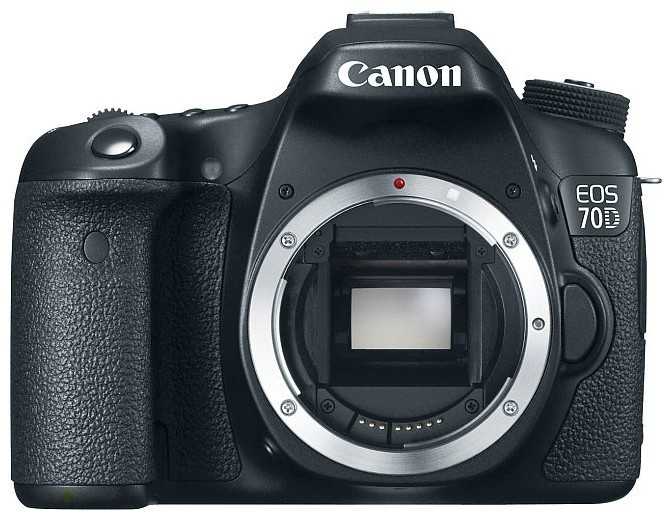
Отзывы о Фотоаппарат Canon EOS 70D Body


Где купить
Фотоаппарат Canon EOS 70D Body
|
Фотоаппарат Canon EOS 70D Body, черный | Яндекс Маркет | 67 800 ₽ | Посмотреть |
|
Фотоаппарат Canon EOS 70D Body, черный | Яндекс Маркет | 70 000 ₽ | Посмотреть |
Плюсы по отзывам пользователей - Почему стоит купить Canon EOS 70D Body?*
*Плюсы и минусы, которые пользователи называют чаще всего на основе практического опыта использования.
- Революционный автофокус Dual Pixel в Live View и видео:
- Плавный и точный следящий AF без "рысканий", идеален для видео с STM-объективами (упомянуто в 70%+ отзывов).
- Тач-фокус на экране позволяет быстро перефокусироваться касанием, меняет подход к съёмке (видео, макро).
- Значительно лучше предыдущих Canon DSLR, как у камкордера.
- Поворотный сенсорный экран:
- Удобен для видео, макро, съёмки с земли/над головой (20%+ отзывов хвалят отзывчивость как на смартфоне).
- Автоповорот изображения, защита при складывании лицевой стороной внутрь.
- Упрощает навигацию по меню, просмотр, зум (pinch-to-zoom).
- Система автофокуса через видоискатель (19-точечная, все крестовые):
- Быстрый и точный, лучше 60D/650D, хорошо отслеживает движущиеся объекты (птицы, спорт).
- Зоны фокусировки, программируемая кнопка переключения режимов AF рядом с затвором.
- Юстировка AF по 40 объективам по серийникам (решает фронт/бэк фокус).
- Эргономика и управление:
- Удобный хват, два колеса, топовый LCD-экран с настройками (15%+ отмечают как у 7D/6D).
- Большой светлый видоискатель (98% покрытия), электронный уровень в нём.
- Глубокая кастомизация кнопок, режим C, бесшумная съёмка.
- Скорострельность и буфер:
- 7 fps (лучше 60D), 14-15 RAW / 35+ JPEG на быстрой SD-карте (Sandisk Extreme Pro).
- Идеально для экшена, спорта, птиц в полёте.
- Качество изображения и ISO:
- Рабочие ISO до 3200-6400 (лучше 60D/T2i), чистые шумы, отличная детализация 20 МП.
- HDR в камере (3 кадра, RAW-поддержка в мультиэкспозиции).
- Точный экспозамер (63 зоны), хорошая цветопередача.
- Аккумулятор и автономность:
- 900+ снимков на VF, LP-E6 совместим с 5D/7D (20%+ хвалят долгий срок).
- Меньше расход в VF-режиме.
- Wi-Fi:
- Удалённое управление с iOS/Android, передача фото (EOS Remote app).
- Полезно для таймера, просмотра на смартфоне.
Минусы по отзывам пользователей - О чем стоит задуматься перед покупкой:
- Проблемы автофокуса через видоискатель (дефектные копии):
- Фронт/бэк фокус на центральной точке с быстрыми объективами (f/2.8 и шире, 20%+ жалоб, включая 3+ замены).
- Мягкие фото vs Live View, QC-проблемы Canon (не все копии, но часто).
- Тест: на штативе f/2.8 VF хуже Live View.
- Wi-Fi неудобный и глючный:
- Медленный (10 сек/фото), слабый сигнал (5м), нельзя видео с Wi-Fi вкл.
- Сложная настройка, не для iPad, тормозит софт.
- Автоотключение экрана не работает с Wi-Fi.
- Только один слот SD-карты:
- Риск потери данных, нет dual-slot как у 7D (10%+ минус).
- Медленный буфер на длинных сериях RAW.
- Отсутствующие функции для видео/фото:
- Нет headphone jack, AF assist lamp, кнопки WB (10%+ жалоб видеографов).
- Перегрев при длинном видео (ERR 70/80), моаре, шум микрофона с USM.
- Нет 60p Full HD, цифровой зум без AF.
- Шумы и динамический диапазон:
- Шумы с ISO 6400+ (хуже Nikon, banding), мало улучшений vs 60D (15% отмечают).
- Мыло от шумодава на видео ISO 1600+.
- Корпус и эргономика:
- Пластик (не Mg как 7D), маркий, маленький задний диск, шумный затвор.
- Пыль на зеркале/матрице при смене объективов.
- Другие нишевые проблемы:
- Нет GPS, battery grip не от 60D.
- Underexposure с bounce flash.
584 отзывов пользователей о Canon EOS 70D Body
Пользовались
Canon EOS 70D Body?
Поделитесь своим опытом и помогите другим сделать правильный выбор

Скромный эксперт
03.04.2014
10/10
Оценка пользователя
Великолепно
The 70D is targeted at advanced photo and video hobbyists, packing cutting edge technology and sophisticated features into a compact body. It's also a familiar camera--at least to EOS shooters--feeling like a marriage of prior models: form factor and controls of the 60D and AF and viewfinder of the 7D. Toss in Wi-Fi, enhanced high ISO, a new 20.2MP Dual Pixel CMOS and that's the 70D in a nutshell.CONSTRUCTION boasts superb fit and finish: polycarbonate body shell, matte black paint and stainless steel undercarriage for strength. Thick textured rubber and finger groove make for a secure grip. The shutter has the same metallic click-clack as the 60D and is louder than the 7D and 6D. Fortunately, silent drive mode fades operation to pianissimo, making it idea for stage and ceremonies.Like the 60D, the 70D has a crystal clear 3.0" 1,040,000 dot LCD. The big deal is the addition of touch screen ability. Touch sensitivity is as good as an iPhone 5 and ideal for LiveView shooting in dim light. The swivel LCD is handy for video and ground level macro. The only negative of the LCD is it hits L-plates and flash brackets when swiveled to the side.CONTROLS: DSLRs are about control and nobody buys one to use in full auto. Don't like the results of auto exposure or AF? They're easy to override or directly control. Plus, controls and features may be customized, allowing multiple ways to do the same thing. For example, I assigned electronic level activation to the DOF button and programmed C mode with my favorite drive, AF and exposure settings.Buttons and wheels feel solid and can be operated while looking through the viewfinder. If coming from a 50D or 7D, you'll need to adjust to the lack of a joystick, flash exposure compensation (FEC) button and white balance button. However, you can assign FEC to the SET button and a FEC scale appears in the viewfinder. Finally, the 7D's toggle switch for LiveView and video migrated to the 70D, a big improvement over the 60D's clumsy Mode dial video.AUTOFOCUS: The 70D inherited the 7D's blazing fast 19-point cross type AF array. I found it senstitive and sure-footed in most light. Canon only included three of the 7D's five AF modes: zone, manual selection and 19-point auto. Spot and expanded point AF are MIA. Nevertheless, a big step up from 9-point 60D AF.Using single point AF mode (manual selection of a single point) and a tripod, I shot test patterns both flat and inclined with several lenses. AF was highly accurate, locking on the point I selected on my inclined ruler. And it was consistent in performance from close focus to infinity. On the other hand, the 19-point auto select mode didn't do well with the ruler (flat target was fine). It was not able to guess which line I wanted in focus and varied with each shot. I expected this to happen but it illustrates photographers need to control the point of focus and shouldn't expect cameras to read their mind. All three modes performed perfectly at infinity and with flat objects.New DSLR users need to understand that the three main AF modes are not designed to recognize human faces like a point and shoot or iPhone. However, face recognition AF is available in LiveView and video modes.In real world use I found auto focus excellent. However, there are dozens of AF options and it took me weeks to figure out what worked best for me. Manually selecting individual AF points is amazingly accurate: near 100% hit rate for difficult subjects, e.g., macro or tight facial portraits (lock on an eye). On the other hand, 19-point auto-select is fast--press 'n lock--but often guesses wrong--maybe a 75% hit rate. Cameras aren't smart enough to make a choice between a rock, tree or cloud, so I avoid 19-point auto select mode and full auto. Finally, Zone focus is the best of both worlds: you pick the zone--top, bottom, center, right or left--and the camera guesses at the subject within the selected area. Zone focus is perfect for stopped down shooting with wide angle lenses and shooting from the hip, e.g., street photography, close to a 100% hit rate when used for the right situation.IMAGE QUALITY is the same as the 60D from ISO 100 to 800, i.e., great! I developed RAW images in Aperture and DPP and was pleased with the detail, color rendition and noise control. At ISO 1600 and above the 70D pulls away from the 60D with a notch better noise performance. The 70D has slightly less noise than the 60D at high ISO but, most significantly, noise is less prone to banding artifacts and more grain-like. Also, grain-like noise is easier to control with noise reduction plug-ins like Topaz Denoise: I can squeeze out another stop of acceptable high ISO over my 60D (or lift shadows more aggressively).VIDEO: I'm primarily a still photographer but shoot video occasionally. And yet I found video operation on the 70D surprisingly easy. First, contrast detection AF during video is a mammoth improvement from previous DSLRs: faster, movie servo AF grabs faces like magic and
Скромный эксперт
24.02.2014
10/10
Оценка пользователя
Великолепно
Buying a new camera is so difficult... at first i couldn't decide between this camera, or taking the plunge and going full-frame with the only slightly more expensive 6D, or just waiting for the oft-rumored but finally (apparently) confirmed 7D mark II... but i went with the 70D, and I am happy with my decision, here's why:Although i do shoot a decent amount of still photography, I mainly wanted a dslr for filmmaking and videography. If you're reading this review, you already know about the 70D's insanely cool autofocusing technology. Let me tell you this.. it is worth the hype! it definitely works. Whether you're focusing on the foreground, background, or anything in between, with just a tap of the touchscreen the 70D will smoothly and decisively pull focus right to where you want it, every time, without the nasty searching/bouncing back and forth that made autofocus infamously unusable on older cameras/autofocus systems. I think that lots of filmmakers are so used to pulling focus manually that they scoff at the idea of an autofocus system doing the work for them, but it makes nailing the shot so much faster/easier, so why not?! It has facial tracking, so you can really just set the camera up, frame your scene and roll, and have all the confidence in the world that whether your talents are approaching or moving away from the camera or whatever, they will stay in perfect, crisp focus. This allows me to shoot faster lenses at really wide apertures for that glorious shallow depth of field all dslr filmmakers lust after, and not worry about the talent's face going out of focus with the slightest head bob.I bought the 70D body only without the STM kit lenses most are shipping with. On my nifty fifty canon 50mm 1.8 i get fantastic image quality, but the lens motor does make a bit of noise, that can sometimes be noticeable. This is the same with my Tamron 28-75 f2.8 (fantastic lens for the 70D, by the way)(<-- SAD DAY!It's actually not, see edit below) but it doesn't matter much to me since i record audio separately away from the camera with a zoom recorder anyway, and just sync later in post, but apparently these new STM lenses are whisper quiet, so they would take care of that focusing noise, if it mattered to me. At some point i plan on purchasing the 40mm 2.8 STM pancake lens, because i hear it's a great bargain lens for this camera, and it wouldn't hurt to have that silent shooting option if needs be, but for now the main lenses that i use, the 50mm and 28-75mm, are just fine on the 70D.I also really like the articulated touch screen, it is so convenient! My first night of shooting with the 70D i had to stand on a rickety ladder and hold the camera up above my head to get the shot that i wanted. On a normal camera this would have been impossible as i couldn't see the screen, but not on the 70D! it was a cinch to simply flip out the screen and rotate it down to easily pull focus and see what i was filming. It can also be very useful when you have to be in front of the camera, and are still trying to control what goes on behind it, as you can just rotate the screen all the way forward, and not to have to pester whatever unlucky friend you roped into helping you film your project every five seconds about what the shot looks like, lighting, focus, etc.I have read several reviews making the bold claim that the 70D is in fact the greatest APS-C sensor camera...ever. I have to say that from the little time i've owned it, i can see why. In the past i have mostly shot on on an older 7D. Head to head, the 70D barely edges out the 7D, but yet the 7D is still like four or five hundred dollars more! The 70D gets you 2 more megapixels, the articulated touch screen, wifi onboard (which i have yet to use, but still) and of course the wondrous video autofocus, as well as the ability to shoot stills in live mode, which is very cool. Both cameras are weather sealed, so there's that. I do miss the solid built-like-a-tank magnesium body of the 7D, but the 70D is simply a better camera all around, and as it should be, it's like 5 years newer!Some reviewers have mentioned that the quick control wheel/dial thing feels cheap and rather chintzy, and i have to concur, it's definitely the 'cheapest' feeling part of the 70d, but with the the other dial on the front near the shutter button as well the touch screen i never really have to use that dial anyway, so it's not really a big deal.Photography wise, i am getting fantastic photos, as i expected. A nice fast frames per second shooting speed and a large enough buffer make shooting lots of pictures very quickly in RAW a breeze, and thus far the camera has performed very well in low light conditions. I have yet to really test the high iso-to-noise ratios, but i expect to perform decently in this aspect as well.Overall, i am very, very pleased with my purchase of this camera. If you're into filmmaking and can't afford a full frame camera, this is the one for you. The autofocus makes eve
Скромный эксперт
17.02.2014
6/10
Оценка пользователя
Плохо
Second Update (3/15): I tried another sample and phase detection autofocus works a lot better on this one. Maybe not as good as I would expect, but the keeper rate is considerably higher. If this would have been my first copy, I probably would have never noticed (as I would not have looked at it that critically). The noise is surprisingly a little worse than on my first copy and matches that of my T2i exactly. So I bumped it up a star, but not back to the original 4 stars, given the existence of QC problems and lack of improvement in sensor performance.===========================================================================================================================Update: While I was able to get some nice shots in earlier sessions (primarily with the 400mm lens), I did encounter the autofocus problem now that others have noticed with faster lenses. It seems to be limited to the center autofocus point, but in certain shooting situations, it missed focus in about 30-50% of my shots. In comparison, my old T2i, while not perfect, missed only 3% with the same shots and lens and the 6D was perfect. I wanted to like it and gave it a few more tries and chances, but the results were consistent (in a bad way). Not acceptable in my book.===========================================================================================================================I understand that the "game changing" capabilities of this camera are on the video side, but I don't shoot a lot of video and there are plenty reviews out there on that topic. Just briefly, I did try it out and it is a tremendous step up. I was able to take well focused and shake-free footage with both the 18-135mm STM kit lens as well as my 24-105mm L lens, without really trying much...My main review though is for the still image use and comparing it to my aging T2i (which this will replace) and my Canon 6D. I have not had the camera for long, so I'm not covering close to all features, but focus on the primary ones (80/20 rule).It was between the T5i, 60D and the 70D for me, prior to picking the 70D.Pros:- While just a bit smaller, the body is almost identical to the 6D, with similar layout and pretty much the same feel (which I love). For some, who want more ruggedness, such as found in the 7D or 5D's, this might be a negative. However, if I look at my trusty Rebel T2i, which has been used in rain, on the beach, thrown in the backpack on many bike rides and abused in hours and hours of astrophotography sessions (usually covered in frozen dew), it still looks and behaves almost like new. So I think the 70D will do just fine.- Touch flip screen. I like my buttons and I am slow to adjust to what the touch screen offers, but I am catching on. Especially selecting the focus point by touch is a nice feature. Responsiveness is just as good as on my iPod Touch.- Auto-focus. I have not explored it in detail, but out of the box it works great. I often take photos of birds in flight and I got a lot more keepers compared to my other bodies. The camera was tracking nicely when shooting a low flying eagle against the background of trees and fields.- 7 fps. Works like a charm (after I got used to the somewhat tinny sound of the shutter).- Good kit lens. Comes surprisingly close to the 24-105mm L lens, but with a wider range and a lot lower price. I posted a separate review under the individual lens item on Amazon. In summary, well worth it the extra money.- Wireless. Same as the 6D. Using your smart phone or iPad/iPod as a remote, without much complications, is something that I got hooked on with the 6D.- Long exposure behavior (I use it for astro pictures at 2-5 minute exposure) is really no difference to the already great T2i. Some stated concerns that the new sensor design (with the split photodiodes per pixel) might have a negative impact here. But based on first tests, it does not.Cons:- Image quality is pretty much the same as with the T2i. Now, the T2i has great image quality (especially based on the year when it came out), but noise and dynamic range are practically the same. In fact, I can't tell the difference between unprocessed results from both sensors, even at 100%, for ISO 800 and below. Only for higher ISO and longer exposures one can see a little improvement (but not much more than you can expect in variances from the same sensor model). The only significant difference is that DPP takes a lot longer to generate the high definition view... Now, in a way, that still justifies having a full frame camera (and I prefer the smaller APS-C sensor for astrophotography and wild life), the 6D is just an order of magnitude better when it comes to image quality, but one could have hoped for some improvements over the last 4-5 years here. Others have done it.Note: Some report significant low light performance improvements over the older 18 MP sensor, but you might want to check the noise reduction settings in DPP. For the same camera setti
Скромный эксперт
06.12.2013
10/10
Оценка пользователя
Великолепно
After using my Canon Rebel T1i/500D for about 4 years, and investing in some nice lenses (EF-S 18-55mm f/2.8 IS USM, EF 50mm f/1.4 USM, EF 70-300mm f/4.0-5.6 IS USM) I decided I needed to upgrade my camera body and take advantage of some of the latest technology to improve my shots. I have had the Canon 70D for about a month now, and I am super happy with my purchase so far.I had two main reason for wanting an upgrade to my camera body: (1) I wanted improved AF options, as with the shallow depth of field of some of my lenses, I often had a hard time using the AF on the T1i and getting the right object in focus. The T1i has a limited number of AF points, no Cross-Type points, and manually selecting the AF point is not easy on the T1i. (2) I have started shooting more video with my DSLR, and I was intrigued with the Dual Pixel auto-focus ability of the 70D. When choosing a new body, I narrowed my choices down to the 6D and the 70D. In the end, I chose the 70D because of the increased number of cross-type AF points (19), and the new Dual Pixel AF for shooting video, and it comes at a lower price (while clearly sacrificing some of the image quality of the full-frame sensor on the 6D). I also got to keep all my current lenses with the 70D, whereas my EF-S lenses would not have worked on the 6D.After shooting with the 70D for a month, here are my impressions so far:Pros:-AF! The Auto-Focus is light years ahead of the T1i, and my shots have improved significantly as a result. I love the ability to switch quickly between the 3 different AF options by hitting the small button next to the shutter release button. I usually leave it in the Auto-Selection AF mode, and found that the 19 cross-type AF points do a MUCH better job of auto-selecting the focus points. When the camera doesn't select the right objects, I usually switch to single-point selection, and then use the toggle on the back of the camera to move to the correct point. I can do all of this in about 1-second while still looking through the viewfinder the whole time.-Flip-Out Touch-screen LCD: I didn't realize how much I would like this, but I really do. I have used the flip-out option several times when shooting at odd angles using the LiveView option, or when shooting video. The touch-screen also works very well, with all the familiar gestures from your touch-screen phone (swipe to view next photo, pinch to zoom, etc.). I also like that in Live-View, I can simply touch the screen on the point I want the camera to focus on, and the camera focuses to that point and releases the shutter.-WiFi: I have found the WiFi most useful for using the EOS Remote app on my iPhone to remotely view photos, or control the camera from my iPhone. Similar to the camera's own touch-screen, I can use a "LiveView" on my iPhone and simply touch my iPhone screen on the focal point and the camera focuses and releases the shutter. You can also remotely change all the settings of the camera from the phone. I have also used the WiFi to transfer photos to my computer, but its pretty slow, so I usually just use the USB cable instead.-Drive Modes: The camera has a lot of great drive modes, including a burst-mode of 7 per second. I also like that is has a silent drive mode, which is something I didn't have on the T1i and is great when shooting during a quiet event.-Dual-Pixel AF with video. This works as advertised, and I found playing the the 3 different AF options to be really easy to use and intuitive. You can either have it auto-focus and track faces (works well if the face isn't moving too fast), AF zone mode (meaning you choose a certain zone of the screen and the camera focuses on whatever moves into that zone), or just touch a point on the screen and the camera will focus to it until you touch somewhere else.-Viewfinder: The viewfinder is light years ahead of my T1i. I can tell much more easily if I am in focus and I also have enjoyed using the level option (a little icon tells you if you are holding the camera level or tilting it to one side or another).Cons:-The camera is much bigger and heavier than the T1i. In some ways this is better to balance out the weight of some of my lenses, but still it is definitely heavier and larger than what I am used to holding/carrying for the last 4 years.-Plastic-feel - I was hoping for over $1,000+ camera-body that it would feel less plasticky, but unfortunately this one does not. I guess you need to move up to the 5D to get a more metallic-feel to the camera.-Focus noise in video. While the AF works well in video, unless you have the new STM lens, the focusing makes a lot of clicking noises that are picked up in your video. My USM lenses are really loud in the video. I really wish now that I had gotten the kit-lens so I at least had one STM lens for shooting video, especially when I know I want the ambient audio to sound clean and am not just planning to dub over music or something.-Only one card slot. Would have
Скромный эксперт
30.08.2013
10/10
Оценка пользователя
Великолепно
This is going to be short, since I've not had the chance to do a whole lot of shooting as yet. Consider it a "just out of the box" impression. I already have a Canon 5D Mk III, and a number of L series lenses. I wanted a "backup camera" for video shooting, and I was intrigued by the new auto-focus system offered on the 70D.So far, I'm extremely pleased with this camera. The 18-35 mm kit lens gives a lot of range, and I tested the camera out with my other lenses. The L series lenses work very well, and auto-focusing is fast, smooth, and doesn't search around much even in very low light. The camera is not as heavy as the 5D Mk III, but feels solid enough, and not all that different in the hands. Even with the 70-300mm f4-5.6L IS USM zoom - my heaviest lens at the moment - the camera feels surprisingly balanced.The crop sensor obviously changes the effect of the lenses, but having a full sensor and a crop sensor both, it's like having 2 sets of lenses. My 70-300mm zoom now has an effective reach up to 480 mm (on the Canon 70D) due to the crop factor of 1.6. To me, this is kind of a bonus, though not in itself a reason to buy the camera. Smaller sized sensors result in an apparent increase in focal length, and a greater depth of field, but this is a generalization and each lens has its own properties that affect the image as well. Read the reviews of individual lenses when considering how each one reacts to different types of camera bodies.The main thing to take note of is that while the Canon 70D will accept all the EF and EF-L lenses, it is designed to use the EF-S series lenses as well. In fact, the EF-S series lenses are custom tailored specifically for the Canon 70D and (as far as I know) other APS-C crop sensor cameras made by Canon. These lenses - and the kit lens is one of them - will not work on a full frame camera like the Canon 5D mkIII; the rear element extends back into the camera body in a way that makes it impossible to attach lenses of this series to full frame sensor cameras. Even if they could be attached, I suspect the captured image might suffer from serious vignetting and other problems.For a thorough understanding of how the APS-C, full frame and other types of sensors interact with various lenses, I highly recommend doing some research on the web. There's a lot of good information out there, and this is a fairly involved subject that I don't even want to attempt to dive into here :)One thing I couldn't figure out before having the camera in my possession deserves a mention. This is my first experience with a fold-out LCD screen on a DSLR, and I had no idea how the display would deal with flipping around 180 degrees. Would it be upside down? This was the first thing I tried, and the screen auto-flips when it is rotated. Maybe everyone else already knows this - but I didn't! Anyway, the fold-out display is a great feature, and it also folds face-in to protect the display when not in use.The ability to touch various points on the LCD display while in Live View or shooting video, and shift focus while shooting is - to me at least - worth the price of admission. If Canon eventually updates the 7D and/or the 5D Mk III, this functionality would be most welcome!Purely as a "gut reaction" - I really like the 70D immensely. And it seems a very good value for the price. This may actually become my preferred "walk-around camera, though time will tell.EDIT - 10/22/2013: I've spent a lot more time with the camera now, so I can add to my earlier comments.While I purchased the 70D mainly for shooting video, I recently used it to shoot bracketed exposures for HDR (high dynamic range) panoramas. A friend of mine had a nodal camera head (The "Ninja" head) which allowed for precise rotation of the camera to cover a full 360 degree field-of-view. The Canon 70D allows for up to 7 bracketed exposures via the AEB controls. The plates were shot in the RAW (CR2) format, using the kit lens, and stitched together using PTGui software.After some initial trial runs, where we ironed out the kinks in the whole process, the results were exceptional. For those who may be wondering "why do you want a 32 bit HDR 360 panorama at 10k-16k resolution?" it is used to create realistic lighting and reflections in a 3D/CG software (i.e. Modo or Maya, for example). The 3D scene can be lit entirely by the 360 panoramic image, producing a very convincing result.At any rate, the Canon 70D delivered terrific results doing something I didn't even foresee when I bought the camera. I will try and upload some of the tests (where the photographic panorama serves as both background and light-source) if I can figure out how to do so on the Amazon site.EDIT - 11/9/2013: A note to anyone who intends to shoot green screen (for color keyed composites) or do precise color grading in post production: The video output from the 70D is not YCbCr 4:2:2 compression. This is not apparent to the naked eye when viewing the video footage, but it becomes an i
Скромный эксперт
29.08.2013
10/10
Оценка пользователя
Великолепно
I like this camera a lot. It's a vast upgrade from the 60D, combining the best features of that body, the T5i, 6D, and 7D, with superior movie motion tracking. It's the first DSLR I can recommend for amateur video without a caveat for slow autofocus. Shooting stills from the rear LCD still favors mirrorless and hybrid bodies, but employing the 70D's viewfinder pulls the advantage back to Canon.I've listed the history of this line so you can get a feel for where it slots.MODEL EVOLUTION:==== 50D /200815MP9-point AF, all cross-points6.3 fps, 16 raw96% viewfinder640 x 480 LCDAF micro-adjustmentAF joystickFlash sync socketCF memory cards==== 60D /2010+ 18MP+ 1080p/720p/480p movies+ Mono mic+ 720 x 480 LCD+ LCD articulates+ Metering improved+ White balance improved+ Wireless flash control+ HDR / MSNR / exposure merge+ Raw conversion and filters on-camera+ Movie crop zoom (7X, 480p)+/- SD cards+/- simplified button layout-- 5.3 fps, 16 raw-- no AF joystick-- no AF micro-adjust-- no flash sync socket-- lesser build==== 7D /2009+ 19-point AF, all cross-points+ 8 fps, 25+ raw+ AF joystick+ AF micro-adjust+ Magnesium chassis+ 100 % viewfinder+ Flash sync port+ Weather-sealing(ish)+ Video sound level adjustment+/- CF cards+/- larger-- 640 x 480 LCD-- LCD won't articulate-- Movie crop zoom-- HDR / MSNR / exposure merge==== 70D /2013+ 20 MP, noise improved+ 'Dual Pixel AF' in Live View+ LCD articulates+ LCD touchscreen+ 720 x 480 LCD+ Wifi built-in+ Silent-shooting w/ viewfinder+ Scene Intelligent Auto mode+ Stereo mics+ Video compression improved+ Movie crop zoom (3X, 1080p)+ HDR / MSNR / exposure merge+/- SD cards+/- smaller+ /- weather sealing+/- simplified button layout-- 7 fps, 16-23 raw-- no AF joystick-- no spot-AF or AF-point expansion-- no flash sync port-- lesser buildViewed from another angle, here's where we've seen the major features before:* 20MP sensor* Dual-Pixel AF* 16-shot raw buffer, 60-shot jpeg buffer (60D)* 19-point AF system (7D)* Swivel LCD screen (60D)* Touchscreen LCD (T5i)* Simplified rear control layout (6D)* Wifi (6D)* AF micro-adjustment (7D)* Stereo microphones (T5i)* Silent shooting through the viewfinder (5D III)* Movie crop zoom (T3i)* IPB and ALL-I video compression (5D III)* On-camera raw conversion, movie editing, and effects preview (T5i)* Scene Intelligent Auto mode (T5i)It's like a greatest-hits album; there's almost nothing from the parts bin that hasn't made an appearance.HANDLING AND NEW FEATURES:No surprise: it feels like a 60D. Small compared to the 40D/50D/7D, but without the handling compromises you'd see moving to a T5i. General build is fine except for the mushy buttons. It isn't brickish like the 7D and the other two to a lesser extent. The difference shows up on the scale: this body mirrors the 60D and weighs 6 ounces less than the 7D, splitting the difference between that and a T5i. Good for travel, though lens weight tends to dictate the DSLR experience at this level.Canon has rejiggered the button layout to match the 6D. A new button near the shutter changes AF modes. Five buttons have switched functions relative to the 60D. Menu adjustments are faster because you can use both thumbs. If you're shooting multiple bodies, the 70D pairs best with a 6D, and the 7D with the 5D III. Earlier bodies require more acclimation.Coming from the 40D/50D/7D, I'm not keen on the rear dial and D-pad. The dial works, it's just small. The D-pad, though, is at least an inch from the AF-on button. If you're using it for direct AF point selection and the AF-on button to AF, you'll wear out your thumb in a hurry. The 40D/50D/7D all have a separate hat-switch in a more ergonomic position. That aside, there's the question of weather-sealing. Regardless of what Canon says, pretend it's a sieve if you're in more than a drizzle. The 'it got wet' repair isn't cheap and the kit lenses aren't sealed.The big addition for the 70D is the touchscreen. The implementation is straight from the T5i: if you can adjust a setting with the physical UI, you can adjust it by touch. This significantly lowers the EOS learning curve. The touchscreen is capacitive and almost as responsive as a modern smartphone, unless you're wearing non-conductive gloves.How does touch change things in practice? If you're a novice, it makes things accessible. Press the Q button to pull up all the major camera functions and tap to adjust. If you're more advanced, it simplifies autofocus. You don't have to place focus points on your subject or pan a focus box with the D-pad. Just tap. It's so much faster. This yields huge dividends when coupled with LCD articulation for off-angle shooting (of high or low objects), studio shooting from a tripod, and most especially with movies, where you have no time for adjustments and don't want to shake the camera by mashing buttons. Picture review also benefits. Phone gestures (e.g., pinch zoom, swiping) make checking focus vastly quicker and more flexible than on any other non-touch EOS camera.W
Скромный эксперт
28.11.2013
10/10
Оценка пользователя
Великолепно
I just purchased this beauty with the 18-55 STM lens and the 55-250 IS lens kit. This is my first DSLR, making the jump from point and shoot zoom camera (Panasonic FZ100). I am very impressed with the image quality in low or ambient light, where the ISO is under 1000. What I am trying to figure out however is how to zoom while in autofocus? The camera was attractive to me because of the revolutionary auto focus (AF) feature (which works great) and the ability to do video recording without have a camcorder. Well for the camcorders/ zoom camera with video taping capablities I have used, I am able to manually adjust the zoom to pan out or in on my subjects. However in reading the literature I am warned not to adjust the zoom rings when in AF mode. So unless I am missing something, how can the camera be comparable to a camcorder?11/30 UpdateSo I have had more time to work with the camera and getting used to its ergonomics. I strongly recommend that if you are not familiar with the Canon ergonomics to play with it for a while and acclimatize yourself. There are lots of buttons and dials to press and turn plus the LCD touch screen options, so you have a lot of ground to cover in just knowing what and when to press what. But not to worry, for beginners devote the time to understand the fuctions of the buttons, dials and icons (it is like learning a foreign language, increased use is required for mastery). I am working with the A+ (Automated) basic mode for starters, (which essentially makes the camera a point and shoot) and reading the instruction manual as I go along. (Yes that is a must as you tend to press buttons and you can get unexpected results). So I have video-taped (and yes I was able to use the zoom rings on the lens to pan in and out) for the most part th AF works brilliantly, as I was moving the camera across the objecs in my viewing area it failed to focus as it could not make up its mind what the primary object was due to a change in the backdrop as the camera moved horizontally across the plane of view. That is so minor, but I thought you should know and I doubt very much if some will notice this) The quality of the images are very impressive and moreso if you use the Canon supplied software to do some post edting. I take the pictures both in RAW format and JPG to get a sense of comparision. Please note RAW takes up more memory than JPG. I also purchased the PNY 62GB SXD memory card, I would rather have more than less. So I may post additional updates as I continue to use the camera. I will be going to the Caribbean next week, which will give me ample opportuity to test the camera even more.12/1 UpdateSo the journey continues and I am really liking this camera, especially once you get over the initial shock and adjustments to the ergonomics and user experience. Canon engineers put a lot of thought into making thi a powerful "easy to use" camera. Dare I say read the supplied instruction manual on the CD (not the handbook) and with camera in hand to cover each section slowly until you get familiar with the settings and usage. I ued the telephoto 55-250mm IS supplied kit lens and was blown away with image accuracy and quality of the close up shots. I did some close ups of outdoor and family indoor shots under varying lighting conditions and in all instance great images. Once you have played enough with the A+ (Fully Automatic Shooting) mode, I recommend going to the SCENE (Special scene) mode and work through those settings (Page 81 on the PDF instruction manual). Again each scene mode has auto features enabled (Aperture setting: measuring how much light is allowed to hit the sensor ( f/1 to f/5.6). The smaller the denominator the wider the aperture, hence allowing more light from the subject to fall on the sensor). Shutter speed, how long th shutter remains open 1/x is also set automatically, as well as the ISO setting.) If you are new to DSLR I strongly recommend you spend some time understanding what these 3 terms mean and how they influence the quality of the picture taken. As promised I will provide an update once I return from my Caribbean trip, based on what I have seen so far I am excited.
Скромный эксперт
17.11.2013
10/10
Оценка пользователя
Великолепно
There's so much to love about this camera that deciding where to start is a challenge.My absolute favorite feature on this camera is that you can easily attach your smart phone to it. Via wifi one can control the shutter or transfer pictures wirelessly. You can see exactly what the camera sees from your phone's screen! This is a great feature because you don't have to buy a dedicated shutter release.Canon was super smart about how they implemented this wireless connectivity. The camera itself creates an access point that your device can attach to. Once you've connected your phone to the camera's hotspot you just launch the Canon app. You can even change the shutter speed and aperture on the camera from your phone.The screen on this camera is AWESOME! It can pivot and turn allowing you to take pictures without being forced to look through the eye hole. The screen is vivid and colorful. Oh, and by the way, the screen is touch controlled. At first I kind of laughed at this feature, like "ha, who would ever use that?" I can't tell you how awesome the touch screen is, it's sensitive and accurate and a complete pleasure to work with. What's better is that almost every control you might ever need to adjust while shooting is accessible through the screen, meaning you don't have to fumble around with buttons, knobs or navigate menus to adjust your shot settings.The 70D has a reasonable HDR shooting mode, which is a function I always want on my cameras. Some of the Sony cameras have pretty awesome HDR, taking up to 7 pictures to combine together. The 70D can take 3 pictures at different exposures and combine them together, which in many cases is adequate.Of course the picture quality is astounding on Canon's 70D. Right out of the box I took 3 pictures of friends in my house that just blew me away. I knew after 10 minutes of shooting with this device that I made the right purchase.I've owned the Canon 20D and 50D in the past. One thing that always drove me crazy was that the battery meter. The meter previously had four indications, Full, Medium, Low and flashing (very low). On my previous cameras the battery meter would show full, then be at low, skipping the midrange all together. The Canon 70D's battery meter is far more accurate, meaning you aren't surprised by a dead battery all of a sudden.While we're at it, the battery life is superb on the 70D.I never really cared much about shooting video with my cameras before. The 70Ds video shooting is SO incredibly good that I am now looking for opportunities to record things! Last night I recorded my friend's harp recital. I was standing in the doorway across the room and just using the built in microphone. The sound was good (though one can purchase a wireless microphone for better sound), and the video quality was out of this world.The only real complaint I have with this camera is that it seems challenged by scenes with highly differing contrasts. The first evening after receiving the 70D I went for walk a little bit before sunset. I was taking pictures of brick buildings with the sky above them. The brick looked overly dark and lacked detail. I had several other similar experiences shooting with bright skies. The pictures were so concerning I called Canon tech support (which was excellent by the way). They looked at my raw images and said the camera was fine.After using the 70D for some time now I've learned to compensate by setting the ISO to auto or adjusting the metering mode. Most DSLRs I've owned have had their own "personality." Learning the nuances of these cameras takes a little time.All in all, this is by far the best camera I've ever owned. I can't recommend it enough!
Показаны отзывы 1-8 из 584.
Где купить
Фотоаппарат Canon EOS 70D Body
|
Фотоаппарат Canon EOS 70D Body, черный | Яндекс Маркет | 67 800 ₽ | Посмотреть |
|
Фотоаппарат Canon EOS 70D Body, черный | Яндекс Маркет | 70 000 ₽ | Посмотреть |
График изменения цены Canon EOS 70D Body
Характеристи Canon EOS 70D Body
Информация о характеристиках носит справочный характер.
Перед покупкой уточняйте характеристики и комплектацию товара у продавца
Обзоры и руководства на Canon EOS 70D Body
Похожие товары с лучшей оценкой







Wizemart © 2026.
Рекомендательная система по умному выбору товаров по отзывам и рейтингам
